|


| |
This page is dedicated to review opinions and analyses
around the world about the Israel - Hezbollah War*, 2006 in Lebanon.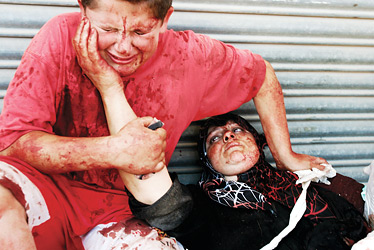
* N.B. The CDL will continue to refer to this war as the Israel - Hezbollah war
so long as the Lebanese government has not officially entered the war or
declared war against Israel.
Around the World:
In Israel:
In Lebanon:
A Cease-Fire Reality: Dealing
With Syria
By Dennis Ross
The Washington Post, August 17, 2006
In 1993 and 1996 I helped broker understandings that brought conflicts between
Hezbollah and Israel to an end. Both times Hezbollah instigated warfare with
Katyusha rocket fire into Israel and Israel retaliated, determined to damage
Hezbollah's capacity for making war and to demonstrate to the Lebanese the cost
of Hezbollah's adventures. And both times, to bring about an enduring
cease-fire, we needed to deal with Syria.
This time, however, the cease-fire deal was done without the Syrians. The
question is: Can the terms of U.N. Security Council Resolution 1701 be fulfilled
without Syria being part of the equation? It doesn't seem likely. Implementation
of this resolution will depend to a large degree on the Syrians -- unless, of
course, the new international force deployed with the Lebanese army can both
prevent resupply to Hezbollah and bolster Lebanon's military so it can fulfill
the role envisioned for it in the resolution.
The more determined Syria is to frustrate implementation of the resolution, the
more the international force will need a capability and a mandate to be
aggressive in stopping efforts to get arms to Hezbollah and in preventing its
restoration as a fighting force. Will the international force have intensive
inspection capability? Will it be deployed along all routes into Lebanon from
Syria and be able to inspect all relevant vehicular traffic? Will it set up
checkpoints on north-south access routes in Lebanon to do the same? And can
15,000 soldiers be organized to perform these roles while also preventing
Hezbollah from training and rebuilding its fortifications in the area from the
Litani River to the Israeli border?
In theory it's possible that the multinational force will be able to meet these
challenges. But given how quickly it must be constituted and deployed, there is
every reason to believe it will not be able to accomplish such a mission anytime
soon. Even in the best case, the forces are not likely to be aggressive if it
means disrupting commerce between Syria and Lebanon or actively depriving
Hezbollah of weapons that it seeks. (Already the French foreign minister has
declared that he does not foresee disarming Hezbollah.)
To be sure, the implementation of the letter and the spirit of the resolution
will also depend on the Lebanese government and army. Both institutions remain
fragile, and Syrian opposition could exploit ongoing sectarian differences. With
the international community ready to bolster the Lebanese government with forces
and reconstruction assistance, there has never been a more promising moment for
the Lebanese to act on their national obligations. They need to know that
assistance, while forthcoming, will be tied over time to their government and
their army living up to their responsibilities.
But there should be no illusions. History is full of good resolutions on Lebanon
that have not been implemented because the Syrians had the power to block them.
At a time when Syrian President Bashar al-Assad is calling Hezbollah's victory a
defeat for U.S. plans in the Middle East, and Secretary of State Condoleezza
Rice is proclaiming that implementation of Resolution 1701 will constitute a
strategic setback for the Syrian regime, can Syria's behavior be altered to make
this U.N. resolution's fate different from those of its predecessors?
It can if we take advantage of the new basis that exists to exercise much more
leverage on Syria this time. Consider that the French and other Europeans will
now be putting forces on the ground in Lebanon. If Hezbollah is being resupplied
with arms and can be reconstituted militarily, those forces will become very
vulnerable. That gives the French a powerful stake in preventing Hezbollah from
rearming.
Working in tandem, the Bush administration and the French should try to change
the Syrian calculus. Syria sees Hezbollah as a card -- something to be exploited
to make Syria a factor in the region or to be traded in the right circumstances.
We should create a one-two punch with the French to make clear that Syria has
something significant to lose by not cutting off Hezbollah, and that it has
something meaningful to gain from changing course.
Surely, if the international force is seen as credible and determined, it can
convince Assad that Hezbollah is going to be contained and that its value to
Syria could diminish. But Assad must also see that Syria will pay an
unmistakable price if it tries to block implementation of Resolution 1701. That
price could be a joint French-E.U. and American effort to isolate Syria
economically if it is unwilling to end its material support for Hezbollah.
The Europeans currently provide a critical economic lifeline to the Syrians.
French President Jacques Chirac could credibly warn Assad that if arms flow to
Hezbollah and threaten French troops, then Europe will cut all economic ties to
Syria. Conversely, if Syria ended its military relationship with Hezbollah and
accepted the Lebanese government's effort to reestablish its authority, the
European Union could promise new and meaningful economic benefits to Damascus.
In such a scenario, the European Union would be Act 1. Act 2 would involve the
United States. The Bush administration, which has expressed an interest in
weaning Syria away from Iran, won't be able to do that without talking to the
Syrians. And it won't be able to do it by continuing to make threats that have
no consequences. It will not be enough to continue saying, "The Syrians know
what they need to do."
The United States must reinforce a tough E.U. message with one of its own to
Assad, namely this: We are prepared to implement a range of sanctions, including
the Syrian Accountability Act and executive orders that would make it difficult
for companies and financial institutions that do business in Syria to conduct
business in the United States.
This would have the potential of choking off European, Asian (and even Arab)
countries and businesses from having any commercial or investment relations with
Syria -- and it could be devastating for an already weak economy. That's a lever
that should be deployed to build the Syrian interest in cooperating.
No doubt the Syrians would want to know what they'd get from such cooperation.
They should be told that the page can be turned in our relations, that economic
benefits could be forthcoming, and that even a resumption of the peace process
between Syria and Israel on the Golan Heights could be in the offing. None of
these things can be available if Syria is not prepared to cut off Hezbollah and
Hamas. Why, after all, would we invest anything in a peace process when those
two organizations retain the means -- with Syrian support -- of subverting that
process at a time of their choosing?
History is littered with well-intentioned efforts to transform Lebanon. If the
current effort is to be different, we will need a credible international force
shaped by real, not symbolic, missions and a new approach to Syria -- one that
gives the Syrians a reason to calculate their interests differently.
The writer was director for policy planning in the State
Department under President George H.W. Bush and special Middle East coordinator
under President Bill Clinton. He is counselor of the Washington Institute for
Near East Policy.
Analysis: Less 'a state
within a state'
Barry Rubin
THE JERUSALEM POST | Aug. 14, 2006
In his statement welcoming the cease-fire, US President George W.
Bush spoke of such positive provisions as its establishing "an embargo on the
supply of arms to militias in Lebanon... a robust international force to deploy
to southern Lebanon in conjunction with Lebanon's legitimate armed forces" and
"the disarming of Hizbullah" to stop it "from acting as a state within a state."
Actually, if Hizbullah is becoming less of "a state within a state" it is only
because it is gaining more power over the Lebanese state.
The first meeting of Lebanon's cabinet to discuss sending soldiers to the south
broke up in disorder. According to Lebanese press reports, ministers argued
heatedly over whether it would take any actions to stop Hizbullah from doing
whatever it wanted. A minister was quoted as saying that Hizbullah refused to be
disarmed and that was the end of the matter.
One of those standing by Hizbullah is Michel Aoun, the Christian leader most
successful in the last election. His party lavishes praise on Hizbullah. While a
majority of his community opposes his stance and will likely abandon him in the
future, Aoun is the one who has the votes in parliament.
In response, Lebanese Christian leader Cardinal Nasrallah Sfeir told Der Spiegel
magazine, "Unfortunately, there are also some Christians who make arrangements
with Hizbullah - if only for tactical reasons." If, however, Hizbullah ever took
power, "the Christians will leave the country in droves."
Hizbullah, Aoun and all the pro-Syrian politicians might be able to put together
a government or at least could block the current government from doing anything
effective. Since the Christian and Druse militias oppose Hizbullah and the
Lebanese army is pretty much non-existent as a real fighting force, this also
means that the only real armed group on which the government depends is
Hizbullah itself.
The international community is expecting that a government controlled by
Hizbullah and Syria will implement an agreement to disarm Hizbullah, dismantle
its independent power and prevent it from attacking Israel.
If this contradiction is so obvious, why doesn't anyone in power in the West see
it? Moreover, the "Hizbullah side" enjoys Iranian and Syrian funding for both
military purposes and reconstruction patronage, while the Christian, Druse and
Sunni opposition get no help from the West. Indeed, international funds and
military assistance will go to the Lebanese government, which means that the
West, too, funds pro-Hizbullah forces.
There are two political lines in Lebanon. One is that Hizbullah is a heroic
organization battling the evil Israelis, this struggle should take primacy and
Iranian and Syrian influence is a positive factor in Lebanon.
The other is, in Sfeir's words, that Lebanon should not be a "battleground for
other states... We refuse to tolerate proxy wars on Lebanese territory."
Palestinians should have their own state but, "The struggle for Palestine cannot
be fought from Lebanon, the smallest and weakest state in the Arab world."
Iran, says Sfeir, is "the greatest danger for Lebanon" as it sends numerous arms
and money there. "How can an independent state be expected to tolerate that?"
Many Lebanese agree with Sfeir. But unfortunately, the answer to his question
is: a country run by those who support this situation ideologically, benefit
from it politically or financially, doubt that the West will help those who want
to fight for a free democratic Lebanon and are intimidated by Hizbullah's
readiness to shoot them.
* Barry Rubin is director of the Global Research in
International Affairs (GLORIA) Center, Interdisciplinary Center.
Cease-fire: Dispelling
Two Imminent Clouds
By Chibli Mallat*, Lebanon
New York Times | August 14, 2006
The Lebanese are holding their breath. Will the cease-fire, which started this
morning at 8 am, hold ? No one dares imagine what happens if it doesn't, but an
extraordinary phenomenon developed this morning as thousands of southern
residents took to the road back to their villages, voting literally with their
feet for a return to peace and normalcy. Another encouraging dimension was the
announced withdrawal of Israeli troops, signaling that there is no Israeli
desire to stay in Lebanon should the cease-fire hold under the terms of UNSCR
1701.
Two heavy clouds remain: one concerns the low threshold of a nervous Israel,
which turns any incident into a risk for hell to break loose. Incidents are
inevitable on an imbricate terrain where Israeli soldiers and Hezbollah
militants form a fuzzy map. One or two Hezbollah militants were killed today,
and the repetition of such incidents would quickly undermine the truce. Speaking
to the Knesset this afternoon, the Israeli Prime Minister announced Israel's
intention to continue its pursuit of Hezbollah. War would be again inevitable if
these threats were carried out against Hezbollah's leadership.
This cloud is reinforced by the one cast by the ambiguity of Hezbollah, which
professes support to the cease-fire, but considers it has the right to shoot at
Israeli soldiers so long as they stay on Lebanese soil.
Both clouds should be forcefully dispelled, by lessening the zero-tolerance
attitude of Israel and opposing a Hamas-like decapitation policy, and by working
on removing Hezbollah's ambiguity. I do not have the means to help on the first
score, although I find the absence of open military preparations for foreign
troops to move into the south a grave failure of the international community.
The clause in Resolution 1701 requesting Israel to withdraw as early as possible
should be taken seriously, and rapid withdrawal is contingent on foreign troops
taking over. One does not yet see tangible signs of these troops, except for
talk about the readiness of some countries to deploy them eventually. The
Security Council had ample time to show such troops to be ready for immediate
deployment in South Lebanon. Any delay brooks risk, and the dynamic of peace
should be reinforced by far greater dynamism on this score.
On Hezbollah's ambiguity, I expressed my opinion forcefully on Lebanese and
Egyptian national television yesterday. There is no way armed Hezbollah
militants can remain between the Litani River and the border. Should attacks be
leveled against Israel, as the leadership of Hezbollah is trying to argue on the
basis of a revival the so-called 1996 Israel-Lebanon Cease-Fire Understanding,
peace will be immediately wrecked. That agreement was reached against a very
different set of circumstances, as Israel was refusing to leave South Lebanon,
and a stopgap modus vivendi developed to lessen civilian casualties on both
sides. Today the peace plan introduced by UNSCR 1701 is based on the premise of
a quick Israeli withdrawal and the parallel, exclusive deployment of
international and Lebanese troops. There is no room for halfway measures that
allow combat to resume in any form.
The ambiguous refusal by Hezbollah to vacate the South militarily already
occasioned a serious crisis in the Council of Ministers, which failed to convene
yesterday because the two Hezbollah ministers were reluctant to endorse that
specific requirement of UNSCR 1701. This is not acceptable. Should Hezbollah
boycott the Council of Ministers or refuse to conform to that clause, they
should leave the government. Having been a year ago the first person in Lebanon
to advocate the participation of Hezbollah ministers in government, against a
decade and a half of a tacit understanding between Syria and the United States
that they should be kept out, I feel morally compelled to speak out. When I
suggested last year that Hezbollah should not be prevented from participating in
government, I also insisted on the necessary quid pro quo: they could do not
continue to operate as a separate armed force outside the law. Lebanon paid
dearly for this weakness.
To protect the cease-fire, accelerate Israeli withdrawal and give a chance to a
lasting peace on the border, the choice is clear: either Hezbollah ministers
stay in government, and conform to UNSCR 1701, which was formally accepted by
Lebanon; or they leave government and stay in opposition. Conforming to UNSCR
1701 means an end to Hezbollah's military presence south of the Litani River and
the recovery of all the land reoccupied by Israel since July 12 by the Lebanese
army and an enhanced U.N. contingent. In a second stage, it includes the
participation of Hezbollah in Lebanese political life exclusively as a Lebanese
political, not a military, movement. As Lebanese, we cannot allow this oddity to
remain, and cannot afford another war.
*Chibli Mallat is a professor of law at Saint-Joseph
University in Beirut and a candidate for president of Lebanon.
Who? Me?!
....it is altogether impossible to win this war
By Uri Avnery
August 09, 2006
TODAY, THE war entered its fifth week. Hard to believe: our mighty army
has now been fighting for 29 days against a "gang" and "terrorist organization",
as the military commanders like to describe them, and the battle has still not
been decided.
Yesterday, military sources in Israel announced that 400 of the 1200 Hizbullah
"terrorists" have been killed. That's to say, a mere 1200 fighters have been
standing against the tens of thousands of our soldiers, who are equipped with
the most advanced weapons on earth, and hundreds of thousands of Israeli
citizens are still under rocket fire while our soldiers continue to be killed.
WHO? ME? Now everybody already admits that something basic has gone wrong
in this war. The proof: the War of the Generals, that previously started only
after the conclusion of a war, has now become public while the war is still
going on.
The Chief-of-Staff, Dan Halutz, has found the culprit: Udi Adam, the chief of
the Northern Command. He has practically dismissed him in the middle of the
battle. That is the old ploy of the thief shouting "Stop thief!" After all, it
is obvious that the person mainly to blame for the failures of the war is Halutz
himself, with his foolish belief that Hisbullah could be defeated by aerial
bombardment alone.
But it is not only at the top of the army that mutual accusations are flying
around. The army command accuses the government, which is retaliating in kind.
On the eve of his downgrading, Udi Adam publicly accused the government of tying
his hands. Meaning: the government is guilty. Ehud Olmert did not remain silent
and declared that the army had not submitted any plans for widening the
campaign. That's to say: if you are incompetent, don't blame me!
To justify himself, Olmert added a significant sentence: "From the first day of
the war, the government has not refused the army a single request!" In other
words, it is the Chief-of-Staff who makes policy and conducts the war, while the
political leadership just rubber stamps everything that the army "requests".
But this is a sterile debate, because it ignores the main fact, which is
becoming clearer from day to day: it is altogether impossible to win this war.
That's why nothing is working as planned.
PLAN? WHAT PLAN? Years ago the military commentator of Haolam Hazeh, the
magazine I was editing at the time, got fed up with the boast the our army
excels in improvisation. "The ability to improvise," he wrote, "Is just another
name for our inability to plan."
According to the reports, the Israeli army has been preparing for this war for
more than three years. The last exercise took place a month before the war
started and included the invasion of Lebanon by land forces. It is clear that
the command did not anticipate a campaign that would last for four weeks and
more. What the hell! After all, it was against a small gang of terrorists. This
just confirms the dictum that even the best war plan does not survive the first
day of war.
THE WAR OF THE POOR. It is quite clear that the army command's wonderful
plan did not include the defense of the rear within rocket range. There was no
plan for the solution of the hundred and one problems emanating from the attack
on Hizbullah: from the protection of the civilian population from thousands of
missiles to the necessary economic arrangements when a third of the country's
population is living under bombardment and is paralysed.
Now the public is crying out, and soon the ministers and generals will have to
try to find somebody to blame for that, too.
For this war is being fought on the backs of the weak, who cannot afford to
"evacuate themselves" from the rockets' area. The rich and well-to-do have got
out long ago - in Israel as well as in Lebanon. The poor, the old, the sick and
the handicapped remain in the shelters. They are the main sufferers. But that
does not cause them to oppose the war. On the contrary, they are the most
vociferous group in Israel demanding "to go to the end", "to smash them", "to
wipe them out".
That is not new, either: the weakest in society always want to feel that they
belong to the strongest nation. Those who have nothing become the biggest
patriots. And they are also the main victims.
Those who initiated and planned the war cynically flatter the inhabitants of the
North, who are stuck there, calling them "heroes" and lauding their "wonderful
steadfastness".
UNITED CYNICS. Now the end of the killing depends on the UN.
David Ben-Gurion called it contemptuously "UNO-SHMUNO" (UM-SHMUM in Hebrew). In
the 1948 war, he violated its cease-fire resolutions whenever it suited him (as
a soldier I took part in some of these actions). He and all his successors over
the years have violated almost all the UN decisions concerning us, arguing (not
without justification) that the organization was dominated by an automatic
anti-Israeli majority, consisting of the Soviet bloc and Third World countries.
Since then, the situation has changed. The Soviet bloc has collapsed and the UN
has become an arm of the US State department. Kofi Annan has become a janitor
and the real boss is the US delegate, John Bolton, a raving neo-con and
therefore a great friend of Israel. He wants the war to go on.
The name of the American game is: to give the Israeli army more days, and
perhaps more weeks, to go on with the war, to pursue the mirage of victory,
while pretending to make great efforts to stop the war. It seems that Olmert has
promised Bush to win after all, if given time.
The new proposals of the Beirut government have lit red lights in Jerusalem. The
Lebanese government proposes to deploy 15 thousand Lebanese troops along the
border, declare a cease-fire and get the Israeli troops out of Lebanon. That is
exactly what the Israeli government demanded at the start of the war. But now it
looks like a danger. It could stop the war without an Israeli victory.
Thus a paradoxical situation has arisen: the Israeli government is rejecting a
proposal that reflects its original war aims, and instead demands the deployment
of an international force, which it objected to strenuously at the start of the
war. That's what happens when you start a war without clear and achievable aims.
Everything gets mixed up.
GENERALS AND COMMENTATORS. I have a proposal to solve all the problems
caused by this war: to switch the generals and the commentators.
The generals have not excelled in conducting the war. But they and their
comrades, the ex-generals, have proved themselves excellent commentators. They
have crowded everyone else out of the studios, created a national consensus and
silenced all real criticism. (Except one sort of criticism: Why do we not
advance deeper into Lebanon? Why haven't we reached the Litani? Why don't we go
beyond the Litani? Why don't we eradicate the Lebanese villages from the face of
the earth?)
On the other side, the broadcasts prove that the military commentators know
exactly how to wage the war. They have forceful opinions and plenty of expert
advice. They know when to advance and where, which troops to deploy and what
weapons to use.
So why not let them conduct the war?
MACHOSTAN. The battery of generals that appears every evening on all TV
channels in order to give a "briefing" (a.k.a. propaganda) to the nation, are
all male. They bring with them a token woman, a real beauty who bears the title
of "army spokesperson" and serves mostly for diversification. The commentators
on TV are, of course, tough guys, and so are almost all the other speakers.
The rule of males is underlined by the fact that the Foreign Ministry is headed
by a woman. Since the foundation of Israel, the Ministry of Defense has been the
realm of he-men, who look with disdain upon the Foreign Office, which is always
considered feeble and effete. Now, too, the Foreign Office is a sickly limb of
the "defense establishment". Tsipi Livni, who once aroused hopes, is a parrot of
the army - as Condoleezza Rice is the parrot of Bush.
War is, of course, a matter for men. That's how it was from the beginning of the
human race, and perhaps even before. A tribe of baboons, for example, when faced
with danger, automatically adopts a defensive formation: old males, women and
children in the center, young males in a circle around them. There is only one
difference between them und us: their leader is always the wisest and most
experienced of the tribe.
The love of the human male for war - a phenomenon we have had the opportunity to
observe from close up these last few days - is connected not only with this
biological heritage. War assures the total dominance of the males over society.
It also assures the total dominance of the generals over the state.
If we believed that that would change with a government headed by civilians, we
were obviously wrong. The opposite is true: the civilians who pose as
war-leaders are no better then the generals. A veteran general might even have
learned something from his experience.
I am going now to say something I did not think I would ever utter: It is quite
possible that we would not have slid into this foolish war if Ariel Sharon were
in charge. Fact: he did not attack Hizbullah after the withdrawal in 2000. One
attempt was enough for him. Which proves again that there is nothing so bad that
something worse cannot be found.
The lust for war also explains the talking choir of the hundreds of ex-generals,
who think and talk in unison in favor of the war. A cynic would say: what's the
big deal, after all it's the army that gave them their standing in society. They
are important only as long as the conflict between Israel and the Arab world
continues. The conflict guarantees their status. They have no interest
whatsoever in its resolution.
But the phenomenon is more profound. The army is the crucible for senior
officers. It shapes their world outlook, their attitude and style. Apart from
the settlers, the senior officers' corps - in and out of uniform - is today the
only ideological party in Israel and therefore has a huge influence. It can
easily gobble up a thousand little functionaries like Amir Peretz before
breakfast.
This is why there is no real self-criticism. At the beginning of the fifth week,
the slogans are again: Forwards! To the Litani! Further! Stronger! Deeper!
The Samson Option
Is Hezbollah on the verge of destroying Lebanon?
By Michael Young*
www.Slate.com
| August 7, 2006
Later this week, the U.N. Security Council will probably vote on a draft
resolution dealing with the war in Lebanon. The document is not likely to end
the fighting, but it might prove a major step in that direction. But the more
troublesome long-term question for many Lebanese is the future of Hezbollah if
it insists on remaining armed. Their country lies precariously poised on a
tightrope, and it's the party that holds the balancing pole.
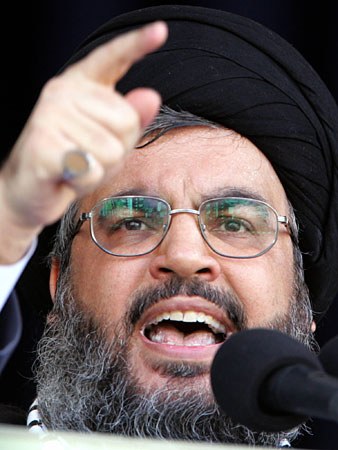
Much has been made of what would constitute a Hezbollah victory in the current
conflict. If the party survives as an effective military force, some have
argued, it will claim victory and transform this into political gains once the
fighting stops. The argument has validity, but its implications may be far worse
given the proliferating problems that will overcome Hezbollah in a postwar
Lebanon—not least the massive human catastrophe the party will have to address
when it again puts on its bonnet as a distributor of social patronage to its
Shiite brethren.
By any measure, Hezbollah is facing a trial of tremendous seriousness. It may
now be benefiting from Israeli indecision in the land war—the party can still
fire rockets across the southern border—but it has also had to watch the
dismantling of the painfully constructed edifice that once bolstered its
domestic legitimacy. To play down this essentially political setback, Hezbollah
has narrowly highlighted its tactical military successes. Down the road,
however, it may try to regain the initiative through a full-fledged coup against
the Lebanese system.
Take Hezbollah's missile capability. In May, Iranian Revolutionary Guards Rear
Adm. Muhammad-Ebrahim Dehqani declared, "We have announced that wherever America
does something evil, the first place that we target will be Israel." While he
did not mention Hezbollah, it was plain that retaliation for an attack on
Iranian nuclear facilities, for instance, would at least partly come from
Lebanon. Last week, Iran's former interior minister, Ali Akbar Mohtashemi Pour,
who helped create Hezbollah, told an Iranian newspaper that Tehran had supplied
the party with long-range Zelzal-2 missiles. These were not intended to defend
Lebanon but rather to place Iran's military deterrent at Israel's doorstep.
While Hezbollah still retains thousands of rockets, mostly shorter-range
Katyushas, can it even consider using them in, let's say, the next decade? With
nearly 1 million people estimated to be displaced, a majority of them Shiites,
and with Lebanon facing an economic calamity from which it won't emerge for many
years, could Hezbollah—or, more important, its base of followers—withstand the
devastating impact of a new Israeli onslaught if the party were to assist its
comrades in Tehran? That's doubtful.
And what of Hezbollah's anchors in Lebanese society? For over a decade, the
armed group used its militancy against Israel, Syria's backing, intimidation,
and Shiite support to protect its independence and prerogatives. This now lies
in tatters. Much has been made of two polls recently released in Beirut,
claiming that more than 80 percent of Lebanese citizens support Hezbollah's
resistance against Israel. These results are simply not borne out by facts on
the ground. Anecdotally, while there may be hostility to Israel in many
quarters, there is no noticeable backing among Christians, Sunni Muslims, or
Druze for what Hezbollah has done. If anything, hostility is being expressed
with greater boldness.
More significant, in closed meetings, Lebanese Prime Minister Fouad Siniora has
said his first priority—and fear—is to avoid the war's feeding sectarian strife.
Officials won't express this openly, partly because Hezbollah is armed and
mobilized, partly because the war continues. But such anxieties—and they
permeate the political class—hardly speak to broad approval for the party. There
has been solidarity with displaced Shiites, though aid workers tell me petty
disputes between refugees of different sects are on the rise. Druze leader Walid
Jumblatt has allowed Shiite refugees in his areas to put up Hezbollah flags and
photographs of the party's leader, Hassan Nasrallah, mainly to reduce Shiite
frustration and avoid clashes with the Druze. In other districts, particularly
Christian ones, however, such flexibility is rarer.
Hezbollah's third test will be to rapidly alleviate the suffering in its own
community and, therefore, avoid losing its base. The party still has substantial
backing among its coreligionists, and it is not about to see this disappear. But
soon the fate of the hundreds of thousands of Shiites now living in schools,
tent cities, and even public parks will be an overriding concern for Nasrallah.
Many have fled areas partly or wholly destroyed, to which they might not return
for months or years. Once they do go back, Hezbollah will have to provide
funding for reconstruction and rehabilitation that is likely to run into the
billions of dollars. With the onset of winter, the party will have a monumental
task to revive not only Shiite morale but confidence that Hezbollah can take
care of its own.
The money will come. Iran and Hezbollah's Shiite finance networks in the Gulf
will surely provide what is needed—they have to. But even the party's most
optimistic interpretation of the current war—that it is a heroic
achievement—will not spare it having to tiptoe very carefully through Shiite
trauma.
And that is what is most potentially worrying. To detract attention away from
its own responsibility for the war, Hezbollah may well choose to go on the
offensive inside Lebanon, politically and even militarily. Instead of facing
Shiite anger, it might opt to redirect it against those Lebanese who, many
Shiites feel, failed to satisfactorily sustain the "resistance" in its
existential struggle against Israel.
This is the essence of Lebanon's dilemma as the war nears its fourth week. Does
Hezbollah agree to integrate itself into the Lebanese political system and
disarm? Or does it exploit its substantial reserves of men and weapons to bring
all of Lebanon forcibly into line with the party's priorities? The first means
the end of Hezbollah as we know it and is a suicide option; the second could
bring Lebanon down around everybody's head in renewed civil war. Call it
Hezbollah's Samson option.
*Michael Young is opinion editor at the Daily Star
newspaper in Beirut and a contributing editor at Reason magazine.
Article Source:
http://www.slate.com/id/2147260/
Stop the Band-Aid
Treatment
We Need Policies for a Real, Lasting Middle East Peace
By Jimmy Carter*
The Washington Post | August 1, 2006;
page A17
The Middle East is a tinderbox, with some key players on all sides waiting for
every opportunity to destroy their enemies with bullets, bombs and missiles. One
of the special vulnerabilities of Israel, and a repetitive cause of violence, is
the holding of prisoners. Militant Palestinians and Lebanese know that a
captured Israeli soldier or civilian is either a cause of conflict or a valuable
bargaining chip for prisoner exchange. This assumption is based on a number of
such trades, including 1,150 Arabs, mostly Palestinians, for three Israeli
soldiers in 1985; 123 Lebanese for the remains of two Israeli soldiers in 1996;
and 433 Palestinians and others for an Israeli businessman and the bodies of
three soldiers in 2004.
This stratagem precipitated the renewed violence that erupted in June when
Palestinians dug a tunnel under the barrier that surrounds Gaza and assaulted
some Israeli soldiers, killing two and capturing one. They offered to exchange
the soldier for the release of 95 women and 313 children who are among almost
10,000 Arabs in Israeli prisons, but this time Israel rejected a swap and
attacked Gaza in an attempt to free the soldier and stop rocket fire into
Israel. The resulting destruction brought reconciliation between warring
Palestinian factions and support for them throughout the Arab world.
Hezbollah militants then killed three Israeli soldiers and captured two others,
and insisted on Israel's withdrawal from disputed territory and an exchange for
some of the several thousand incarcerated Lebanese. With American backing,
Israeli bombs and missiles rained down on Lebanon. Hezbollah rockets from Syria
and Iran struck northern Israel.
It is inarguable that Israel has a right to defend itself against attacks on its
citizens, but it is inhumane and counterproductive to punish civilian
populations in the illogical hope that somehow they will blame Hamas and
Hezbollah for provoking the devastating response. The result instead has been
that broad Arab and worldwide support has been rallied for these groups, while
condemnation of both Israel and the United States has intensified.
Israel belatedly announced, but did not carry out, a two-day cessation in
bombing Lebanon, responding to the global condemnation of an air attack on the
Lebanese village of Qana, where 57 civilians were killed this past weekend and
where 106 died from the same cause 10 years ago. As before there were
expressions of "deep regret," a promise of "immediate investigation" and the
explanation that dropped leaflets had warned families in the region to leave
their homes. The urgent need in Lebanon is that Israeli attacks stop, the
nation's regular military forces control the southern region, Hezbollah cease as
a separate fighting force, and future attacks against Israel be prevented.
Israel should withdraw from all Lebanese territory, including Shebaa Farms, and
release the Lebanese prisoners. Yet yesterday, Prime Minister Ehud Olmert
rejected a cease-fire.
These are ambitious hopes, but even if the U.N. Security Council adopts and
implements a resolution that would lead to such an eventual solution, it will
provide just another band-aid and temporary relief. Tragically, the current
conflict is part of the inevitably repetitive cycle of violence that results
from the absence of a comprehensive settlement in the Middle East, exacerbated
by the almost unprecedented six-year absence of any real effort to achieve such
a goal.
Leaders on both sides ignore strong majorities that crave peace, allowing
extremist-led violence to preempt all opportunities for building a political
consensus. Traumatized Israelis cling to the false hope that their lives will be
made safer by incremental unilateral withdrawals from occupied areas, while
Palestinians see their remnant territories reduced to little more than human
dumping grounds surrounded by a provocative "security barrier" that embarrasses
Israel's friends and that fails to bring safety or stability.
The general parameters of a long-term, two-state agreement are well known. There
will be no substantive and permanent peace for any peoples in this troubled
region as long as Israel is violating key U.N. resolutions, official American
policy and the international "road map" for peace by occupying Arab lands and
oppressing the Palestinians. Except for mutually agreeable negotiated
modifications, Israel's official pre-1967 borders must be honored. As were all
previous administrations since the founding of Israel, U.S. government leaders
must be in the forefront of achieving this long-delayed goal.
A major impediment to progress is Washington's strange policy that dialogue on
controversial issues will be extended only as a reward for subservient behavior
and will be withheld from those who reject U.S. assertions. Direct engagement
with the Palestine Liberation Organization or the Palestinian Authority and the
government in Damascus will be necessary if secure negotiated settlements are to
be achieved. Failure to address the issues and leaders involved risks the
creation of an arc of even greater instability running from Jerusalem through
Beirut, Damascus, Baghdad and Tehran.
The people of the Middle East deserve peace and justice, and we in the
international community owe them our strong leadership and support.
* Former US president Carter is the founder of the nonprofit
Carter Center in Atlanta.
© 2006 The Washington Post Company
Let’s
declare victory and start talking
By Ze'ev Sternhell
Haaretz, Fri., July 28, 2006
It's a widely accepted idea that an Israeli who returns home, even after a short
period of time, feels as if he has come to another country. But the opposite is
the case: He returns to the same situation, the same problems, the same thought
patterns and mainly, the same solutions. Apparently, we did not learn a thing
from the first Lebanon War or from the American defeat in Iraq . If the
definition of Israel 's strategic goal given by the head of Military
Intelligence at the beginning of the week reflects the government's position, we
are in big trouble.
If Israel really did embark on the war in order to force Lebanon to impose its
authority on the south, which is in Hezbollah's hands - or in other words, to
force the Lebanese government to begin a civil war in the service of Israel -
that is a sign that it is dominated by thinking even more primitive than the
thinking that led Ariel Sharon to Beirut about a quarter of a century ago.
But this time, we have exacerbated the problem: At the beginning of the third
week of fighting, in spite of the determination and courage of the attacking
soldiers, the war seems only to be beginning. That is why we should achieve a
cease-fire before the campaign gets out of control, claims victims in vain and,
in the long run, even turns into a strategic failure.
In the more distant future, it will be necessary to carry out a fundamental
structural reform of the government's work procedures and to examine its
dependence on the Israel Defense Forces' General Staff. These are truths that
are not pleasant to voice at this time, but that is the reality, and we are
obliged to confront it.
And in fact, considering the means that the IDF is employing and the ratio of
forces in the field, any outcome less than the elimination of Hezbollah as a
fighting force will be considered an Israeli failure and a great achievement for
the enemy. But since it is impossible to uproot Hezbollah from among the Shiites
without destroying the population itself, wisdom requires us to refrain from
positing goals that are unachievable.
The inability of a major power to put an end to a guerrilla war is not a new
phenomenon: From Napoleon in Spain , through his successors in Algeria , to the
Americans in Vietnam and now in Iraq , well-organized armies equipped with
modern technology have always failed in attempts to defeat irregular forces. The
latter know how to adapt themselves to their surroundings, they are an
inseparable part of the population and they serve its material, religious and
emotional needs.
When there is fighting, guerrilla organizations want the entire population to be
harmed. When everyone is a victim, the hatred will be directed at the enemy more
forcefully. That is why bombing residential neighborhoods, power plants, bridges
and highways is an act of folly, which plays into Hezbollah's hands and serves
its strategic goals: An attack on the overall fabric of life creates a common
fate for the fighters and those standing on the sidelines. At the same time, the
greater the population's suffering, the greater its alienation from the formal
ruling institutions - the government, the parliament and the various security
forces that are powerless to save them.
It is an illusion to hope that the 700,000 Lebanese refugees will direct their
fury at their government, or that the population that still remains in place
will evict the Hezbollah members from among it. As far as the population is
concerned, responsibility for its catastrophe lies entirely with Israel , and
failure to cooperate with whoever fights against Israel would be considered
national treason. It was foolish to assume that the Lebanese political elite
would dare to confront Hezbollah and use force against it. And anyway, who was
even capable of using force? The Lebanese Army, whose bases were bombed as well?
That is why Israel 's interest must be to isolate Hezbollah, to strike a hard
blow at its bases and camps, but to avoid harming the infrastructure of life for
the general population, even when its gives refuge to those bearing arms. This
is not a matter of military ethics, but of a cold practical considerations.
The goal of the war is to restrain Hezbollah, because nobody is dreaming any
longer of destroying it. As things look today, at best, Israel will make do with
removing it from the border. There, behind the back of an international force,
which in the Arab world will in any case be seen as protecting Israel ,
Hezbollah will be able to reorganize, train, equip itself with more modern
weapons and prepare for the next round.
There is no military solution for this situation. IDF Chief of Staff Dan Halutz
has already implied that the solution is political. The prime minister, who
bears overall responsibility and will be required to give an accounting in the
future, would do well not to lag behind the person who in any case will pass him
the hot potato.
And a word about the price of American support. Sometimes it seems as if U.S.
President George W. Bush wants Israel both to destroy Lebanon and to sustain
painful losses. That way, Israel provides him with an excellent alibi for the
war in Iraq : The fight against terror is global, the blood price is the same,
the methods of operation and the means are identical, and the time needed for
victory is long. The Israeli vassal is serving its master no less than the
master is providing for its needs.
World War Three
without the blood, sweat and tears
By Gideon Rachman*
The Financial Times | July 28, 2006
If you are looking for reassurance at this time of international crisis, do not
consult Newt Gingrich. "We are in the early stages of what I would describe as
the third world war," says the former speaker of the House of Representatives,
who is currently a member of the Pentagon's Defence Policy Board. Mr Gingrich is
not alone in his diagnosis. Dan Gillerman, Israel's ambassador to the United
Nations, said last week that: "The third world war, I believe, has already
started. What we're seeing today in the Middle East is a chapter of it." Even
President George W. Bush has casually endorsed the idea. He told a television
interviewer last May that the passengers who fought back against their hijackers
on September 11, 2001 had staged "the first counterattack to world war three".
Symbolically, Mr Bush has placed a bust of Churchill (a gift from the British),
in the Oval Office.
Any argument simultaneously associated with Newt Gingrich, the Israeli
ambassador to the UN and President Bush is likely to be dismissed on those
grounds alone in much of Europe. But the "third world war" crowd deserve a
careful hearing. Essentially, they make two points. The first is that Islamist
extremists are already waging a multi-front war. Fighting is under way in
Afghanistan, Iraq, Lebanon and Palestine – and a confrontation with Iran is
looming. Those inclined to dismiss this multi-front war as essentially a broad
regional conflict are reminded that Islamist terrorists have also struck in New
York, Madrid, London, Bali and elsewhere. The second argument is that these
conflicts are all linked because Islamism is a "seamless totalitarian movement"
– in the words of Michael Gove, a British Conservative member of parliament and
author of a new book on the subject*. Mr Gove and many neo-conservatives in
America argue that Islamism is a direct descendant of the totalitarian movements
of the twentieth century because, like them, it is implacably and violently
hostile to western, liberal democracy.
The British government seems to subscribe to at least part of this argument.
Tony Blair, prime minister, has spoken of an "arc of extremism" from Afghanistan
to the Middle East. And while most British officials are not temperamentally
inclined to talk about "third world wars", they do see worrying links between
the various conflicts. One reason the British have been unexpectedly sympathetic
to the Israeli effort to blast Hizbollah out of existence is that they believe
that many of the roadside bombs used to kill British soldiers in Iraq are based
on technology supplied by Hizbollah.
But the idea of a "seamless totalitarian movement" also has some obvious holes
in it. It requires making almost no distinction between the Arab-Israeli
conflict and the "war on terror". It glosses over the fact that Saddam Hussein
was not an Islamist – and that it was the American-led invasion of Iraq that
turned the country into a honey pot for "Islamofascists" (to use the neo-cons'
preferred term). And it struggles to make sense of the fact that the single
biggest source of bloodshed in the Middle East at the moment is internecine
conflict between Sunni and Shia extremists in Iraq. Indeed, some of those who
now worry most about Shia militancy had convinced themselves a couple of years
ago that the real problem in the Middle East was Sunni radicalism – and that the
Shia were a key part of the solution.
But perhaps the most telling argument against the "world war three" thesis is
that even many of those advancing it do not appear to believe their own
rhetoric. In the same Fox News interview in which Mr Gingrich painted "a
worldwide picture of efforts to undermine and destroy our civilisation", he was
asked by a clearly embarrassed interviewer about those who argue that "look,
this is a costly war and maybe it includes raising taxes on the upper income to
fight it". Mr Gingrich was having none of it. The third world war will
apparently not require "raising a penny in taxes". Clearly, we are not yet at
the blood, sweat and tears phase. The Bush administration is similarly reticent.
It argues that we are engaged in a struggle to save western civilisation. But it
is still all but inconceivable that the administration would re-introduce the
draft – or even sharply raise taxes on petrol – to help win that struggle.
The constant analogies between the war on terror and the war on Nazism do still
matter, however. Choose the wrong analogy and you may end up choosing the wrong
policy as well. Slogans about "Munich" and appeasement have been heard before
some of the worst foreign policy disasters of the past 60 years – such as the
Suez crisis and Vietnam. The same talk was heard before the invasion of Iraq and
is now rife in connection with Iran.
But there have been other events in history besides appeasement and there are
other decades that can be learnt from besides the 1930s. In fact, the struggle
between western liberalism and Islamism may end up looking a lot more like the
cold war than the second world war. In the cold war, people had to get used to
the idea that normal life was taking place against the backdrop of terrifying
risks that could not be eliminated by military action
alone: then it was Soviet missiles, now it is the fear that a terrorist might
get hold of a nuclear bomb. Then, as now, there were episodes of "hot war" – in
Korea and elsewhere. But the cold war ultimately turned on a struggle between
ideologies and social systems, rather than armies.
Communism finally imploded because it could not produce prosperity or a decent
society. Militant Islamism – a miserable, medieval philosophy – is bound
ultimately to go the same way. In Iran, which has had to live with a
fundamentalist regime since 1979, there is plenty of evidence of popular
disillusionment with the system, particularly among the young. It is this
disillusionment that offers the best hope for the kind of "regime change"
that actually lasts. Incapable of offering the hope of a decent life (at least
on earth), Islamism's only real recruiting sergeant is an appeal to a sense of
Muslim humiliation and rage against the west. There may be further occasions
when the "war on terror" requires military action.
But each new military front will be eagerly greeted by Islamists as a validation
of their world view. It is no accident that one man who would happily embrace Mr
Gingrich's vision of a "third world war" is Osama bin Laden.
*Celsius 7/7 by Michael Gove. Orion books.
gideon.rachman@ft.com
© Copyright The Financial Times Limited 2006 "FT" and the "Financial Times" are
trademarks of The Financial Times.
The turnabout
will come quickly
By Meron Benvenisti
No one can predict when the reversal will come, when all the experts will begin
competing for first place in revealing the failures of the war: mistaken
strategy, political dilettantism and shooting from the hip; the weakness
disguised as courageous determination; the illusions, arrogance and boasting;
the addiction to an impulse of revenge; the cruelty and the lack of moral
inhibitions. But the manipulators and the self-declared heroes should not delude
themselves, nor should the naive, or those who are drunk with patriotism or
those who consider themselves experts: the moment will arrive more quickly than
they imagine and within a short while everyone will be hiding| behind the pose
of "we told you so" when they know which way the wind is blowing.
That is when all the declarations, the assessments and the excuses - that
could be uttered and written only in an atmosphere of lack of critical
skepticism that prevails when a "state of war" is declared - will be revealed.
It is only in an atmosphere of this kind that serious people can justify the
destruction of a country on the grounds that they "are helping its government in
this way" to gain the upper hand over Hezbollah - a kind of variation on the
theme of "the raped woman actually enjoyed herself." It is only in an atmosphere
of this kind that a well-bred person can be glad that the lack of American
pressure to stop the bombings makes it possible to continue the killing and
destruction.
Only reliance on patriotic emotions, which cloud any rational thinking, makes it
possible to state without shame - after many days of multi-casualty pounding and
the inexplicable destruction of an airport, highway interchanges, power stations
and entire neighborhoods - that actually this activity was in vain, since it was
known in advance that the bombs could not achieve their objectives and that a
massive ground invasion was unavoidable.
Only people who unabashedly exploit primitive urges allow themselves to
personalize the war and focus it on the annihilation of their enemy, Hassan
Nasrallah. Only those who are convinced the war will bring down a smoke screen
over any cynical or hypocritical act can brag that they are assisting in an
international humanitarian activity after they themselves brought about the
catastrophe.
No one is able to predict the minute when the opposition to the war and the
bloodshed turns from an act of betrayal into a legitimate and even correct
stance; when a moral condemnation of the war's evil effects becomes acceptable
from a patriotic point of view and when slogans like "uprooting terror," "a war
for our homes," "an existential struggle" and their like, turn from resonant
war-cries into empty rhetoric.
No one can predict this, but experience teaches us that the turnabout from
patriotic criticism to rational behavior based on moral norms occurs sooner or
later, sometimes within weeks or months and sometimes after a generation. It
seems that in the current outbreak of violence, the change will come very
quickly; its conduct, objectives and results do not encourage too much
enthusiasm and it has not even been granted the title of "war" since those who
waged it are not sure if they want to commemorate it among the state's official
wars or if they believe it would perhaps be better to forget it.
They cannot allow themselves to think that all should know their assessments
were incorrect, and therefore they will seek a "victory" that will justify all
the loss of life and destruction, and the very need for such a victory will
merely prolong the suffering and bereavement. The public that supports them will
have difficulty demanding soul-searching of them since the tribal solidarity
will protect the political and military leaders.
Very soon everything will return to what it was before - apart from those who
sacrificed their lives and those who were killed in the shellings and bombings.
And the major loser will be the people of Israel who, by an unmeasured reaction
to a provocation, established their position as a foreign element in the region,
as the neighborhood bully, the object of impotent hatred.
Staying On
Why I'm not evacuating Beirut.
By Faerlie Wilson*
July 21, 2006, at 2:36 PM ET
From my balcony this afternoon, I watched as French, British, and American
evacuees boarded chartered cruise ships in Beirut's port about a half-mile west
of my apartment.
And over the last few days, while bombs and artillery pummeled the southern part
of the city, I made the decision not to leave Lebanon. Explosions rock my
building even as I write this, but I'm staying put.
I'm not crazy, and I harbor no death wish. This is simply the rational decision
of someone who has built a life in Lebanon, who believes in this place and its
ability to bounce back. I choose to bet on Beirut.
After five visits to Lebanon over as many years, I moved to Beirut from
California this February. I'm a 24-year-old American with friends but no family
here. But Lebanese hospitality makes it easy to feel at home; it's a warm
society that exudes and embodies a sense of interpersonal responsibility. Live
here for two weeks and then go out of town, and you'll get a dozen offers to
pick you up at the airport upon your return.
So although I'm not Lebanese by blood, I have become Beiruti. There are plenty
of us who fit that description, foreigners who fell in love with the place and
its people. One friend, an American college student interning for the summer
with a member of the Lebanese parliament, called in tears en route to the
northern border to tell me her parents had forced her to leave.
"I'm going to stay in Syria as long as I can," she vowed. "In case things settle
down and I can come back."
Until the war broke out last week, this was to be Lebanon's golden summer—last
year's tourist season having been dampened by the brutal car bomb that killed
former Prime Minister Rafik Hariri in February 2005.
This summer started off strong, with concerts by major Western artists that
allowed the Lebanese to hope their country was returning to the prewar days when
everyone who was anyone—icons like Ella Fitzgerald, Marlon Brando, and Brigitte
Bardot—made regular stops in the country. Ricky Martin and 50 Cent performed in
May and June, respectively, Sean Paul was on deck for July, and negotiations
were under way to bring Snoop Dogg later in the summer. But the most anticipated
concert was set for late July: the three-night return of legendary Lebanese diva
Fairouz to the Baalbeck festival, where she first earned her fame in the 1950s
and '60s.
The after-party for 50 Cent was typical over-the-top Beiruti, held at city's
most decadent nightclub, Crystal. Lamborghinis and Ferraris crowded the parking
lot; plasticated Lebanese girls in short skirts and spike heels danced on tables
as waiters navigated the dance floor balancing trays laden with sparklers and
magnums of champagne for high-rolling Saudi tourists, while Fiddy free-styled
and openly smoked a joint.
Tourists from the Arab world, Europe, and North America flooded the streets of
cities and villages throughout the country. Gulf Arabs in particular have been
drawn to Lebanon, especially in a post-9/11 era when they felt unwelcome in the
West (and often had trouble obtaining visas). Lebanon offered many of the same
attractions as Europe, but in an Arab setting: temperate climate, good shopping,
plenty of tourist activities, and most important, heady nightlife and a liberal
social atmosphere. Tourists partied till dawn, stormed the sales at Beirut's
designer boutiques, and visited sites like Lebanon's ancient cedar groves and
the Roman temples at Baalbeck.
Now those magnificent ruins are surrounded by newer ones: The city of Baalbeck,
long a Shiite stronghold, has received a heavy share of the Israeli bombardment.
Falling bombs erase entire villages, fire and smoke cover the horizon, and
visions of that promised summer have, in just over a week, evaporated. On the
beaches of Damour and Jiyeh, the foreign visitors aren't European sun junkies
but Israeli missiles. And the cruise ships docked in the port aren't bringing
tourists to Lebanon, they're taking them away.
The contrast between Beirut today and Beirut two weeks ago is so stark, it would
be unbearable if it weren't so surreal. This isn't my Beirut. This isn't
anyone's Beirut. The frantic, vibrant city has shrunk into a sleepy town, with
empty streets and only a handful of restaurants, bars, and shops open for
business.
It's amazing how quickly you can get used to living under siege. We've taped our
windows, stocked up on supplies, and settled into a perversion of normal life.
Electric generators succeed where embattled power stations fail. I've learned
what times the electricity, water, and Internet connection usually cut out, and
I plan my days accordingly—an old Lebanese ritual from the days of the civil
wars.
Candles we bought as decoration are scattered throughout the apartment,
half-burned down from long nights without electricity. An Israeli propaganda
flier dropped on a university soccer field sticks out of my roommate's copy of
the now-obsolete July issue of Time Out Beirut, marking a page listing
exhibitions at art galleries that have since boarded up their doors. The
magazine only launched this spring, and it was easy to see it as yet another
symbol that Beirut was finally being recognized as one of the world's great
cities. Travel and Leisure magazine listed Beirut as the ninth-best city in the
world for 2006. In this part of the world, fortunes shift very quickly.
Smaller explosions and the rushing of Israeli fighter jets overhead don't
startle or frighten me anymore. We are exhausted and have to save our emotional
energy for the moments where panic is needed. Still, when larger blasts rattle
my windowpanes and make the apartment shudder, I rush to the balcony to figure
out which part of my city is being hit. Sometimes, it's an easy game: Three days
ago, my roommate and I watched as Israeli warships struck Beirut's port.
I know I'm reasonably safe in my corner of Beirut, and I have a place to go in
the mountains if that ceases to be true. Unlike people in many other industries,
I still have a job: The magazine where I work decided to publish an August
issue—although it will lose money—as a sign of resistance and resilience.
There is painfully little we, the ordinary people of Lebanon, can do to help the
situation. So, instead, we do what we can to help each other by donating food
and supplies, opening our doors to friends and strangers, and trying to maintain
some semblance of normalcy. We aren't giving up.
After the foreigners are gone, local wisdom predicts that the fighting will only
get worse. At the very least, there will be less protective padding—a fear of
foreign casualties that may have restrained Israel to some degree. Evacuating
Beirut would feel a lot like abandoning it. I know that my staying won't keep
the Israelis from intensifying their attacks, but at least I won't be complicit,
seeing events unfold on a TV screen from the comfort of Cyprus.
So, I'll watch those ships pull away without regret. Lebanon has given me more
than I ever could've asked: a home, a sense of belonging, an almost indecent
number of happy memories. But aside from any debt to Lebanon, I won't leave
because I know how miserable I would be watching the war ravage my country from
the outside. As long as my feet are firmly planted on Lebanese soil, I somehow
know the country will survive.
People ask me if I'm scared, and I am—but for Lebanon more than for myself. This
place and its people deserve far better than what they're getting.
There's a sad, unstated "what will become of us?" question floating around the
Lebanese who are left behind. I need to stay here, if only to learn the answer.
*
Faerlie Wilson
is an editorial assistant at
Executive
magazine in Beirut, Lebanon.Faerlie Wilson is an editorial assistant at
Executive magazine in Beirut, Lebanon.
Source: Article URL:
http://www.slate.com/id/2146306/
In Beirut
it - almost - feels like the 1980s all over again
By Roula Khalaf
The Financial Times | July 21, 2006
Two weeks ago I flew to Beirut to leave my son with my parents, as I do every
summer so he can develop roots in a home I left in the 1980s during Lebanon's
civil war. But within days, I was rushing back, to find a country traumatised
and my son experiencing the same relentless reverberation of bombs and rockets I
endured in my childhood. In just a few days, his world had changed and a fierce
Israeli campaign, unchecked by outside powers, was unfolding.
The clock had been turned back 20 years, as Israel had promised, taking with it
Lebanon's culture. Radio stations played, once again, the old revolutionary
songs and reverted to the slogans of resistance to the "Zionist" enemy, to pleas
for refugees and details of evacuation plans.
And,
just like the old days, Lebanon seemed to be a victim in a larger political game
- one in which other players, from Syria to America and Iran, had more important
roles to play and were in no rush to conclude.
At the centre of the conflict is Hizbollah - the "Party of God" - whose capture
of two Israeli soldiers triggered this conflict. It is clear the intensity of
Israel's response shocked the group's members - but only seemed to harden their
resolve.
When I interviewed Hassan Nasrallah, Hizbollah's leader, last year in Beirut, he
told me his group's existence was not based on conflict with Israel. "Hizbollah
is also a political party, which has its programme and its responsibility in the
country," he said. Imbued with Islamist sentiment and reared on blind hatred for
Israel, Hizbollah nevertheless has focused on political transformation,
nurturing supporters through a vast network of social services, providing
everything from education to healthcare.
Yet, curiously, both Israel and Hizbollah appear to have prepared carefully for
this war for months, perhaps even years. Tragically, however, no one bothered to
warn the rest of Lebanon's population.
For Israel and Hizbollah, it is difficult to imagine what either side can
achieve in this war. Hizbollah is no match for Israel's military power; but,
well entrenched in a Shia Muslim society and driven by religious fervour, it is
determined not to be shattered by Israeli fire.
Hizbollah has always been a strange creature in cosmopolitan Lebanon - a party
created with the help of Iran's revolutionary guards to fight Israel's
1982 invasion, that pays religious allegiance to Iranian supreme leader
Ayatollah Ali Khamenei and depends on Syria for the logistical supply of
Iranian-made weapons.
Over the past decade, Hizbollah has been gradually "Lebanised" and its appeal
extended in the Shia Muslim community, the largest minority in a country where
17 different sects co-exist. In the now destroyed southern suburbs of Beirut,
where Hizbollah effectively built a state within a state, the organisation ran
an intelligence network more sophisticated than the central government's - but
also provided a marriage service that helped people furnish their first marital
homes. Although remaining rooted in the Shia community, Mr Nasrallah over the
years also built bridges with other sects, through dialogue with leaders.
So, while in America Hizbollah is still denounced as a terrorist organisation,
held responsible for bombing US marines in Beirut in 1983 and attacking the US
embassy the following year, in Lebanon and much of the Arab world it is seen as
a legitimate resistance group, a status glorified by Israel's withdrawal from
southern Lebanon in May 2000.
After that, Hizbollah insisted it would pursue its military campaign to
"liberate" a small strip of land it claimed Israel had retained. But its attacks
subsided amid fears of alienating ordinary Lebanese, now far less convinced of a
cause for resistance. Hizbollah's leaders threw themselves more deeply into
Lebanese politics. In parliament, the party's slogans shifted from condemnation
of Israel to the fight against corruption and pursuit of social justice.
But it was another military pull-out from Lebanon and geopolitical changes that
upset the party's strategy of political transformation. When Syria was
pushed out of Lebanon last year, after being blamed for the killing of Rafiq
Hariri, the former prime minister, Hizbollah felt vulnerable. Soon, emboldened
non-Shia Lebanese politicians, under international pressure, raised the pressure
on Hizbollah to disarm or integrate its military wing into the army. Hizbollah
stuck to its weapons, and stubbornly maintained support for Damascus. Syria and
Iran, isolated by the US and under growing pressure, became even friendlier,
both seeing in Hizbollah a vital ally.
Israel's strategy has been to pound Lebanon to the point its government and
society turn against Hizbollah. That is why the Shia population of southern
Lebanon has borne the brunt of the violence. Certainly, there is outrage among
non-Shia politicians and people who blame Hizbollah for dragging Lebanon into a
futile war. But so devastating has been Israel's campaign that Hizbollah's
provocation is fading into distant memory.
Shia families, tired and displaced, seem as supportive as ever of Hizbollah.
As one party member told me this week, martyrdom to him was a "wish, not a
fear", and droves of young men were waiting for the opportunity. Those who died
are in heaven, he continued. And Lebanon? It was rebuilt before, he said, and
Hizbollah would help rebuild it again.
*The writer is the FT's Middle East editor
Copyright The Financial Times Limited 2006 "FT" and the "Financial Times" are
trademarks of The Financial Times.
With foolish
determination
By Yossi Sarid
Haaretz: July 23, 2006
Another chronicle of predictable damned entanglement begins. With eyes wide
shut, Israel once again blunders into Lebanon's trap of fools, starting a
"ground activity" it may not be able to get out of for a long and bloody time.
Using lofty platitudes only diminishes the certain danger. "The quagmire of
Lebanon," as the babbling idlers on television say. "The second Lebanon war,"
they say. The path to the killing field is always paved with cliches.
What else can be done to avoid the calamity? I fear the die is cast, and what is
undone will be difficult to undo.
It was clear from the start - or seemed to be - that a ground invasion into
Lebanese territory would be strictly forbidden. Everyone swore there was no such
intention. Precisely because it was so clear and agreed, it raised concern that
walking in the valley of the shadow of death was only a matter of time. This is
what happens, must happen, when leaders raise the expectations of the war to the
sky and then they crash down to earth. When leaders are filled with
self-righteousness, they run out of wisdom.
The height of expectations determines the height of the flames and once
expectations are scorched, they strengthen not only the resolution, but the
stupidity as well. It's a familiar process, defined as "the gambler's syndrome"
- another sort of congenital brain damage caused by chromosomal disorder. The
gambler bets on higher and higher stakes in the reckless hope of restoring his
lost money. In war, the gamble is not for money but for lives, and what is lost
is not money but the honor of the politicians, generals and admirals.
If there were no initial intention of putting troops on the ground and getting
entangled in a net laid out by Hezbollah, Syria and Iran, then why set
unattainable political goals as well? But domestic support or international
indifference has gone to the government's head. Ehud Olmert and Amir Peretz
suddenly think the world that was against us is suddenly for us, and with
hoorahs from home and abroad, they can't pass up the chance of a war.
But this support is like shifting sands, and a few more days of pictures of
destruction and refugees will make it evaporate like smoke over Beirut. And the
United States, the one in Iraq and Afghanistan, will be the only one still
supporting us. The American president alone will continue to massage our backs
as he massaged the chancellor's. She, incidentally, was embarrassed and angered
by it.
What does American support matter anyway? Full of its own interests, the United
States supported - and still supports - its hopeless war in Iraq, which is
bringing disaster on America and world. With its own hands Washington has
sabotaged the post-communist world's deterrent ability. It has enabled Iran,
Syria and North Korea to go crazy. The crazies of the world are uniting and
running amok, and among them are the Taliban, Hezbollah and Hamas.
At the beginning of the first war in Lebanon, in 1982, the United States of
president Ronald Reagan and secretary of state Alexander Haig supported Ariel
Sharon's moves. Shimon Peres, as opposition leader, mocked those who objected to
the war, which he himself had opposed until he changed his skin. "America had
given Begin and Sharon a carte blanche," he explained at the time.
So? Did the American support 24 years ago make that Lebanon war more reasonable?
Will it make this war's ground expansion less idiotic? And who will pay the
price of its unnecessary victims - America or Israel? And if the two wars are
not alike, why are such efforts being made to stress the similarity between
them?
The tragedy is Israeli, but it could be Greek. All is predestined, and there
seems to be no free will and no stopping the headlong rush to disaster.
I beg of Israel's statesmen and generals: Don't try to heal the old Lebanese
trauma with a new one. Don't pick at wounds that have not yet healed; don't send
the soldiers into the valley of the shadow of death. You would do better to
lower your expectations, as would we, so that we don't have to lower our flags
to half mast .
How can
we stand by and allow this to go on?
By Robert Fisk
"The Independent" | 07/31/06 | Source:
http://www.informationclearinghouse.info/article14287.htm
They wrote the names of the dead children on their plastic shrouds. "Mehdi
Hashem, aged seven - Qana," was written in felt pen on the bag in which the
little boy's body lay. "Hussein al-Mohamed, aged 12 - Qana',' "Abbas al-Shalhoub,
aged one - Qana.'' And when the Lebanese soldier went to pick up Abbas's little
body, it bounced on his shoulder as the boy might have done on his father's
shoulder on Saturday. In all, there were 56 corpses brought to the Tyre
government hospital and other surgeries, and 34 of them were children. When they
ran out of plastic bags, they wrapped the small corpses in carpets. Their hair
was matted with dust, most had blood running from their noses.
You must have a heart of stone not to feel the outrage that those of us watching
this experienced yesterday. This slaughter was an obscenity, an atrocity - yes,
if the Israeli air force truly bombs with the "pinpoint accuracy'' it claims,
this was also a war crime. Israel claimed that missiles had been fired by
Hizbollah gunmen from the south Lebanese town of Qana - as if that justified
this massacre. Israel's Prime Minister, Ehud Olmert, talked about "Muslim
terror" threatening "western civilisation" - as if the Hizbollah had killed all
these poor people.
And in Qana, of all places. For only 10 years ago, this was the scene of another
Israeli massacre, the slaughter of 106 Lebanese refugees by an Israeli artillery
battery as they sheltered in a UN base in the town. More than half of those 106
were children. Israel later said it had no live-time pilotless
photo-reconnaissance aircraft over the scene of that killing - a statement that
turned out to be untrue when The Independent discovered videotape showing just
such an aircraft over the burning camp. It is as if Qana - whose inhabitants
claim that this was the village in which Jesus turned water into wine - has been
damned by the world, doomed forever to receive tragedy.
And there was no doubt of the missile which killed all those children yesterday.
It came from the United States, and upon a fragment of it was written: "For use
on MK-84 Guided Bomb BSU-37-B". No doubt the manufacturers can call it
"combat-proven" because it destroyed the entire three-storey house in which the
Shalhoub and Hashim families lived. They had taken refuge in the basement from
an enormous Israeli bombardment, and that is where most of them died.
I found Nejwah Shalhoub lying in the government hospital in Tyre, her jaw and
face bandaged like Robespierre's before his execution. She did not weep, nor did
she scream, although the pain was written on her face. Her brother Taisir, who
was 46, had been killed. So had her sister Najla. So had her little niece Zeinab,
who was just six. "We were in the basement hiding when the bomb exploded at one
o'clock in the morning,'' she said. "What in the name of God have we done to
deserve this? So many of the dead are children, the old, women. Some of the
children were still awake and playing. Why does the world do this to us?"
Yesterday's deaths brought to more than 500 the total civilian dead in Lebanon
since Israel's air, sea and land bombardment of the country begun on 12 July
after Hizbollah members crossed the frontier wire, killed three Israeli soldiers
and captured two others. But yesterday's slaughter ended more than a year of
mutual antagonism within the Lebanese government as pro-American and pro-Syrian
politicians denounced what they described as "an ugly crime".
Thousands of protesters attacked the largest United Nations building in Beirut,
screaming: "Destroy Tel Aviv, destroy Tel Aviv," and Lebanon's Prime Minister,
the normally unflappable Fouad Siniora, called US Secretary of State Condoleezza
Rice and ordered her to cancel her imminent peace-making trip to Beirut.
No one in this country can forget how President George Bush, Ms Rice, and Tony
Blair have repeatedly refused to call for an immediate ceasefire - a truce that
would have saved all those lives yesterday. Ms Rice would say only: "We want a
ceasefire as soon as possible,'' a remark followed by an Israeli announcement
that it intended to maintain its bombardment of Lebanon for at least another two
weeks.
Throughout the day, Qana villagers and civil defence workers dug through the
ruins of the building with spades and with their hands, tearing at the muck
until they found one body after another still dressed in colourful clothes. In
one section of the rubble, they found what was left of a single room with 18
bodies inside. Twelve of the dead were women. All across southern Lebanon now,
you find scenes like this, not so grotesque in scale, perhaps, but just as
terrible, for the people of these villages are terrified to leave and terrified
to stay. The Israelis had dropped leaflets over Qana, ordering its people to
leave their homes. Yet twice now since Israel's onslaught began, the Israelis
have ordered villagers to leave their houses and then attacked them with
aircraft as they obeyed the Israeli instructions and fled. There are at least
3,000 Shia Muslims trapped in villages between Qlaya and Aiteroun - close to the
scene of Israel's last military incursion at Bint Jbeil - and yet none of them
can leave without fear of dying on the roads.
And Mr Olmert's reaction? After expressing his "great sorrow", he announced
that: "We will not stop this battle, despite the difficult incidents [sic] this
morning. We will continue the activity, and if necessary it will be broadened
without hesitation." But how much further can it be broadened? Lebanon's
infrastructure is being steadily torn to pieces, its villages razed, its people
more and more terrorised - and terror is the word they used - by Israel's
American-made fighter bombers. Hizbollah's missiles are Iranian-made, and it was
Hizbollah that started this war with its illegal and provocative raid across the
border. But Israel's savagery against the civilian population has deeply shocked
not only the Western diplomats who have remained in Beirut, but hundreds of
humanitarian workers from the Red Cross and major aid agencies.
Incredibly, Israel yesterday denied safe passage to a UN World Food Programme
aid convoy en route to the south, a six-truck mission that should have taken
relief supplies to the south-eastern town of Marjayoun. More than three quarters
of a million Lebanese have now fled their homes, but there is still no accurate
figure for the total number still trapped in the south. Khalil Shalhoub, who
survived amid the wreckage in Qana yesterday, said that his family and the
Hashims were just too "terrified" to take the road out of the village, which has
been attacked by aircraft for more than two weeks. The seven-mile highway
between Qana and Tyre is littered with civilian homes in ruins and burnt-out
family cars. On Thursday, the Israeli Army's Al-Mashriq radio, which broadcasts
into southern Lebanon, told residents that their villages would be "totally
destroyed" if missiles were fired from them. But anyone who has watched Israel's
bombing these past two weeks knows that, in many cases, the Israelis do not know
the location in which the Hizbollah are firing missiles, and - when they do -
they frequently miss their targets. How can a villager prevent the Hizbollah
from firing rockets from his street? The Hizbollah do take cover beside civilian
houses - just as Israeli troops entering Bint Jbeil last week also used civilian
homes for cover. But can this be the excuse for slaughter on such a scale?
Mr Siniora addressed foreign diplomats in Beirut yesterday, telling them that
the government in Beirut was now only demanding an immediate ceasefire and was
not interested any longer in a political package to go with it. Needless to say,
Mr Jeffrey Feltman, whose country made the bomb which killed the innocents of
Qana yesterday, chose not to attend.
© 2006 Independent News and Media Limited
U.S. risks
backlash in Mideast
Deadly Israeli assault strikes at core of U.S. foreign policy
in region
ANALYSIS by Peter Baker
The Washington Post |July 30, 2006
The Israeli bombs that slammed into the Lebanese village of Qana yesterday did
more than kill three dozen children and a score of adults. They struck at the
core of U.S. foreign policy in the region and illustrated in heart-breaking
images the enormous risks for Washington in the current Middle East crisis.
With each new scene of carnage in southern Lebanon, outrage in the Arab world
and Europe has intensified against Israel and its prime sponsor, raising the
prospect of a backlash resulting in a new Middle East quagmire for the United
States, according to regional specialists, diplomats and former U.S. officials.
Although the United States has urged Israel to use restraint, it has also
strongly defended the military assaults as a reasonable response to Hezbollah
rocket attacks, a position increasingly at odds with allies that see a deadly
overreaction. Analysts think that if the war drags on, as appears likely, it
could leave the United States more isolated than at any time since the Iraq
invasion three years ago and hindered in its foreign policy goals such as
shutting down Iran's nuclear program and spreading democracy around the world.
"The arrows are all pointing in the wrong direction," said Richard N.
Haass, who was President Bush's first-term State Department policy planning
director. "The biggest danger in the short run is it just increases frustration
and alienation from the United States in the Arab world. Not just the Arab
world, but in Europe and around the world. People will get a daily drumbeat of
suffering in Lebanon and this will just drive up anti-Americanism to new
heights."
The White House recognizes the danger but thinks the missiles flying both ways
across the Israel-Lebanon border carry with them a chance to finally break out
of the stalemate of Middle East geopolitics. Bush and his advisers hope the
conflict can destroy or at least cripple Hezbollah and in the process strike a
blow against the militia's sponsor, Iran, while forcing the region to move
toward final settlement of the decades-old conflict with Israel.
"He wants a resolution that will solve the problem," White House spokesman Tony
Snow told reporters yesterday. "Not only do we feel sorrow for what happened in
Qana, but also a determination that it is really important to remove the
conditions that led to that."
"This moment of conflict in the Middle East is painful and tragic," Bush said in
his radio address Saturday. "Yet it is also a moment of opportunity for broader
change in the region. Transforming countries that have suffered decades of
tyranny and violence is difficult, and it will take time to achieve. But the
consequences will be profound for our country and the world."
Broader struggle with Iran
At the heart of the crisis for the United States is a broader struggle with Iran
for influence in the Middle East, one that arguably has been going on since the
Islamic revolution of 1979 and that has escalated during Bush's presidency. The
United States not only backs Israel in the current war but also has accelerated
weapons delivery to Israel. Hezbollah, on the other hand, has long acted as a
surrogate for Iran, and in the past three weeks it has shown off Iranian weapons
never before used by the radical group.
"It's really a proxy war between the United States and Iran," said David J.
Rothkopf, a scholar at the Carnegie Endowment for International Peace and author
of "Running the World," a book on U.S. foreign policy. "When viewed in that
context, it puts everything in a different light."
The Hezbollah attacks on Israel that touched off the latest conflict came just
as international pressure on Iran to give up uranium enrichment had reached a
crescendo. Bush aides suspect Iran orchestrated the attacks to distract
attention from its nuclear program or to demonstrate the consequences of pushing
too hard. "It's tempting to believe that," said a senior official involved in
the crisis but not authorized to speak on the record. "Iran spends a very large
amount of money on Hezbollah."
The president hopes the crisis will ultimately help him rally world leaders
against Iran's nuclear program. Even as the U.N. Security Council today
considers a peacekeeping force for Lebanon, it may vote on a U.S.-backed
resolution to threaten sanctions if Iran does not suspend uranium enrichment in
August.
"There's no question that this is going to stiffen up in the long run the
resolve of the Europeans in dealing with Iran," said Henri J. Barkey, a former
State Department official who teaches at Lehigh University. "Even if they don't
like what Israel is doing," he said, they will recognize that Iran "is a
menace."
Others are not so hopeful. Outside the White House, the mood among many foreign
policy veterans in Washington is strikingly pessimistic, especially as leaders
of Hezbollah and al-Qaeda, traditional rivals based in different Islamic sects,
began calling for followers to take the fight to the enemy.
Analysts foresee a muddled outcome at best, in which Hezbollah survives Israel's
airstrikes, foreign peacekeepers become bogged down, and U.S.
relations with allies are severely strained. At worst, they said, Hezbollah and
Iran feel emboldened, Islamic radicalism spreads, and a region smuggling
fighters and weapons into Iraq fractures further along sectarian lines.
Increasingly isolated U.S.?
"What the conflict has exposed in a really clear way is how linked all these
issues in the region are to each other," said Mara Rudman, a deputy national
security adviser in the Clinton White House now at the liberal Center for
American Progress. "The worst-case scenario . . . is a much more radicalized
Islamic fundamentalist Middle East and much more isolated Israel and a much more
isolated United States and fewer people to talk with."
Haass, the former Bush aide who leads the Council on Foreign Relations, laughed
at the president's public optimism. "An opportunity?" Haass said with an
incredulous tone. "Lord, spare me. I don't laugh a lot. That's the funniest
thing I've heard in a long time. If this is an opportunity, what's Iraq? A
once-in-a-lifetime chance?"
In the long run, he and others warn, the situation could cement the perception
that the United States is so pro-Israel that a new generation of Arab youth will
grow up perceiving Americans as enemies. The internal pressure on friendly
governments in Egypt, Saudi Arabia and elsewhere could force them to distance
themselves from Washington or crack down on domestic dissidents to keep power.
In either case, Bush may have little leverage to press for democratic reforms.
Jon B. Alterman, a Middle East specialist at the Center for Strategic and
International Studies, outlined "not even the worst-case scenario, but a
bad-case scenario: South Lebanon is in shambles, Hezbollah gets credit for
rebuilding it with Iranian money, Hezbollah grows stronger in Lebanon and it's
not brought to heel. The reaction of surrounding states weakens them, radicalism
rises, and they respond with more repression. None of this is especially
far-fetched. And in all of this, the U.S. is seen as a fundamentally hostile
party."
All of this is far too gloomy for administration officials, who see such dire
forecasts as the predictable reactions of a foreign policy establishment that
has produced decades of meaningless talks, paper peace agreements and unenforced
U.N. resolutions that have not solved underlying issues in the Middle East.
"Some of the overheated rhetoric about how the United States can't work with
anybody, we've lost our leadership in the world, is just completely ridiculous,
and this crisis proves it," said the senior administration official involved in
the crisis. "We are really indispensable to solving this crisis, and you're not
going to solve this problem merely by passing another resolution."
While the diplomats work, the Pentagon is studying the possible impact on an
already-stretched U.S. military. Commanders have diverted the 24th Marine
Expeditionary Unit and the Iwo Jima Expeditionary Strike Group from a training
mission in Jordan where they were available as reserves for Iraq. Now they are
on ships in the Mediterranean Sea to help with humanitarian efforts, and another
unit has been put on alert as backup for Iraq.
The Pentagon has done contingency planning for U.S. troops participating in a
multinational peacekeeping mission, but Bush aides have all but ruled out such a
scenario. A more likely option, officials said, would have the United States
provide command-and-control and logistics assistance.
U.S. troops in Lebanon?
Peter W. Rodman, assistant secretary of defense for international security
affairs, said that officials are studying the possibility of putting troops in
Lebanon but that it is too early to comment on what such a force would look
like. "The concept is still under development, and discussion of any potential
U.S. participation would be premature."
Some analysts acknowledge the varied challenges the United States faces but
consider the possible gain worth the risk. "It's a Rubik's Cube. It's very, very
difficult to resolve," said Peter Brookes, a former deputy assistant defense
secretary under Bush who is now at the conservative Heritage Foundation. "But if
we were able to dismantle Hezbollah, that would be very positive for the war on
terror."
The White House is acutely aware of the dangers of stirring up anti-American
sentiment in the region. "There may be times when people say that they're
unhappy with whatever methods we pursue," the White House's Snow said last week.
"We are confident that in the long run, people are going to be much happier
living in freedom and democracy than, for instance, in nations that are occupied
by terrorist organizations that try to hijack a democracy in its formative
stages."
Staff writer Josh White contributed to this report.
© 2006 The Washington Post Company
Spanish Lessons for
Israel
By NICHOLAS D. KRISTOF
Op-Ed Columnist
The Washington Post | July 23, 2006
In 1982, many friends of Israel vigorously supported its invasion of Lebanon,
arguing that it was only assuring its own security.
In retrospect, though, that assault undermined the long-term security of Israel.
The invasion spawned Hezbollah, whose perceived success in driving Israel out of
Lebanon encouraged Hamas and other Palestinian groups to adopt more violent
tactics.
Today again, Israel believes that it is improving its long-term security by
attacking Lebanon. And once again, I believe, that will prove counterproductive.
Israel is likely to kill enough Lebanese to outrage the world, increase
anti-Israeli and anti-American attitudes, nurture a new generation of
anti-Israeli guerrillas, and help hard-liners throughout the region and beyond.
(Sudan’s cynical rulers, for example, will manipulate Arab outrage to gain cover
to continue their genocide in Darfur.) But Israel is unlikely to kill more
terrorists than it creates.
More broadly, one reason this bombardment — like the invasion in 1982 — is
against Israel’s own long-term interest has to do with the way terrorism is
likely to change over the next couple of decades.
In the past, terror attacks spilled blood and spread fear, but they did not
challenge the survival of Israel itself. At some point, though, militant groups
will recruit teams of scientists and give them a couple of years and a $300,000
research budget, and the result will be attacks with nerve gas, anthrax, or
“dirty bombs” that render areas uninhabitable for years.
All this suggests that the only way for Israel to achieve security is to reach a
final peace agreement, involving the establishment of a Palestinian state
(because states can be deterred more easily than independent groups like Hamas).
Such an agreement is not feasible now, but it might be five or
15 years from now. Israel’s self-interest lies in doing everything it can to
make such a deal more likely — not in using force in ways that strengthen
militants and make an agreement less likely.
It’s certainly true that if America were raided by a terror group next door, we
would respond just as Israel has. When Pancho Villa attacked a New Mexico town
in 1916, we sent troops into Mexico. But that expedition was a failure (just as
our invasion of Iraq has been, at least so far).
On the other hand, there are two democracies that endured constant and brutal
terrorism and eventually defeated it. Neither Spain nor Britain was in a
situation quite like Israel’s (Palestinian terrorists have been more brutal in
attacking civilians), but they still offer useful lessons. And both the Northern
Ireland and Basque problems were often considered insoluble a couple of decades
ago, perhaps even more than those in the Middle East today.
Spain could have responded to terror attacks by sending troops into the Basque
country, or by bombing the sanctuaries that ETA guerrillas used just across the
border in France. (France was blasé about being used as a terrorist base.)
Instead, Spain gave autonomy to the Basque country and restrained itself through
gritted teeth, over the objections of those who thought this was appeasement.
Likewise, Britain endured constant bombings by the I.R.A., which enjoyed support
in both Ireland and the U.S. and obtained weapons and Semtex plastic explosive
from Libya.
Yet Margaret Thatcher didn’t bomb Dublin (or Boston), nor even the offices of
the I.R.A.’s political wing in Northern Ireland. When she saw that Britain’s
harsh tactics were strengthening support for the I.R.A., the Iron Lady moderated
her approach and negotiated the landmark Anglo-Irish agreement of 1985. At the
time, that agreement was widely denounced as rewarding terrorists and showing
weakness.
Frankly, neither British nor Spanish restraint was a huge or immediate success.
Spain had hoped that democracy would end Basque terrorism; instead, it
increased. And Mrs. Thatcher acknowledges in her memoirs that her results were
“disappointing.”
Yet in retrospect, the softer approach gave London and Madrid the moral high
ground and slowly — far too slowly — isolated terrorists and made a negotiated
outcome more feasible. That’s why Britain and Spain are today peaceful, against
all odds.
That admirable restraint should be the model for Israel, with the aim of making
a comprehensive peace agreement more likely — in 2010 or 2020 if not in 2007.
The record of Spain and Britain suggests that restraint and conciliation can
seem maddeningly ineffective — but they are still the last, best hope for peace.
History
Will Judge Us All On Our Actions
By Michel Aoun*
Wall Street Journal | July 31, 2006
RABIEH, Lebanon -- While aircraft, sea-craft, and artillery pound our beloved
Lebanon, we Lebanese are left, as usual, to watch helplessly and pay a heavy
price for a war foisted upon us due to circumstances beyond our control.
Considering that this crisis could have been avoided, and considering that there
is -- and has been -- a solution almost begging to be made, one cannot but
conclude that all of this death, destruction and human agony will, in
retrospect, be adjudged as having been in vain.
No matter how much longer this fight goes on, the truth of the matter is that
political negotiations will be the endgame. The solution that will present
itself a week, a month or a year from now will be, in essence, the same solution
as the one available today, and which, tragically, was available before a single
shot was fired or a single child killed. Given this reality, a more concerted
effort is required sooner rather than later to stop the death and destruction on
both sides of the border.
From the outset, this dispute has been viewed through the differing prisms of
differing worldviews. As one who led my people during a time when they defended
themselves against aggression, I recognize, personally, that other countries
have the right to defend themselves, just as Lebanon does; this is an
inalienable right possessed by all countries and peoples.
For some, analysis as to this conflict's sources and resolutions begins and ends
with the right to self-defense; for others, Israel's claimed self-defensive
actions are perceived as barbaric and offensive acts aimed at destroying a
country and liquidating a people. Likewise, some view Hezbollah's capture of two
Israeli soldiers as fair military game to pressure Israel to return Lebanese
prisoners; yet others perceive it as a terrorist act aimed at undermining
Israel's sovereignty and security.
These divergences, and the world's failure to adopt different paradigms by which
Middle East problems can be fairly analyzed and solved, have produced, and will
continue to produce, a vicious cycle of continuing conflict. If the approach
remains the same in the current conflict, I anticipate that the result will be
the same. This, therefore, is a mandate to change the basis upon which problems
are judged and measured from the present dead-end cycle to one which is based on
universal, unarguable principles and which has at least a fighting chance to
produce a lasting positive result.
My own personal belief is that all human life is equal and priceless -- I look
upon Israeli life as the same as Lebanese life. This belief stems not from my
Catholic religion, but rather, from basic human values which have their historic
home in Lebanon. It is no coincidence that a leading figure in the drafting and
adoption of the Universal Declaration of Human Rights was Charles Malek, a
Lebanese citizen.
I ask, will other Arab countries and leaders have the courage to acknowledge
that Israeli life is equal to Arab life? Will Israel have the courage as well to
acknowledge that Lebanese life is equal to Israeli life, and that all life is
priceless? I believe that most Israeli and Arab citizens would answer in the
affirmative. Can we get their governments and their leaders to do the same?
Acknowledgement of equality between the value of the Lebanese and the Israeli
people can be a starting point and a catalyst. The universal, unarguable concept
of the equality of peoples and of human life should be the basis upon which we
measure and judge events, and should provide the common human prism through
which the current conflict, and old seemingly everlasting conflicts, are viewed
and resolved. This is the only way to peace, prosperity and security, which is,
after all, what all human beings desire, regardless of their origin.
The ideological, political and religious differences between the party that I
lead, the Free Patriotic Movement, and Hezbollah, could have been addressed
either through confrontation, or through internal dialogue. Recognizing the
value of human life, the obvious choice was the second option. We sat down with
Hezbollah to discuss our differences.
After many months of extensive negotiations, we came up with an understanding
that included 10 key items which laid down a roadmap to resolve 10 of the most
contentious points of disagreement. For example, Hezbollah agreed for the first
time that Lebanese who collaborated with Israel during Israel's occupation of
south Lebanon should return peacefully to Lebanon without fear of retribution.
We also agreed to work together to achieve a civil society to replace the
present confessional system which distributes power on the basis of religious
affiliation. Additionally, Hezbollah, which is accused of being staunchly
pro-Syrian, agreed for the first time that the border between Lebanon and Syria
should be finally delineated, and that diplomatic relations between the two
countries should be established.
We also agreed that Palestinian refugees in Lebanon should be disarmed, that
security and political decision-making should be centralized with the Lebanese
government, and that all Lebanese political groups should disengage themselves
from regional conflicts and influences.
Last but not least, our extensive negotiations with Hezbollah resulted in an
articulation of the three main roadblocks regarding resolution of the Hezbollah
arms issue: First, the return of Lebanese prisoners in Israeli prisons. Second,
the return of the Shebaa farms, a tiny piece of Lebanese territory still
occupied by Israel. And third, the formulation of a comprehensive strategy to
provide for Lebanon's defense, centered upon a strong national army and central
state decision-making authority in which all political groups are assured a fair
opportunity to participate.
This structure, if joined together with international guarantees which forbid
the nationalization of Palestinian refugees in Lebanon and which protect Lebanon
from Israeli incursions, and if tied on the internal level to a new, fair and
uniform electoral law, is the best hope for peacefully resolving the Hezbollah
weapons issue.
This is the essence of the comprehensive solution we seek. Because it embodies a
shift from a policy based on military force to one founded upon human values and
reconciling the rights of parties, it would stand the test of time. If rights
are respected, and if parties are treated with the deference that they
implicitly deserve as human beings, then the long-term result will be not only
physical disarmament, but also a disarmament of minds on both
sides.
Our party presented this solution internally to all Lebanese political groups,
the Lebanese government, and the international community -- including the U.S.
administration -- repeatedly, for an entire year before this crisis began.
Rather than help us to resolve the weapons issue peacefully and avoid the
current agony our country is now enduring, the international community and
Lebanese government flatly ignored the proposed solution. Many of Lebanon's main
political players cast us aside as "pro-Syrian" "allies" of Hezbollah. No
matter. These are the same individuals who -- only a year before -- branded me a
"Zionist agent" and brought treason charges against me when I dared to testify
before a Congressional subcommittee that Syria should end its occupation of my
country.
You see, after Lebanon was liberated from Syrian occupation, the international
community (apparently enamored by the quixotic images of the Cedar Revolution)
demanded that the Lebanese elections take place immediately and "on time"; it
brushed off our grave concerns about the electoral law in force, which had been
carefully crafted by Syria and imposed upon Lebanon in the year 2000 to ensure
re-election of Syria's favorite legislators.
This flawed electoral law -- initially imposed upon us by Syria and then
reimposed upon us by the international community -- has had disastrous results.
It brought to power a Lebanese government with absolute two-thirds majority
powers, but which was elected by only one-third of the populace. With a
legislative and executive majority on one side, and a popular majority on the
other side, the result was absolute gridlock. Currently in Lebanon, there is no
confluence of popular will with government will, and therefore the government
cannot deal effectively with this or any other problem.
History will judge us all on our actions, and especially on the unnecessary
death and destruction that we leave behind. The destruction currently being
wrought upon Lebanon is in no way measured or proportional -- ambulances, milk
factories, power stations, television crews and stations, U.N. observers and
civilian infrastructure have been destroyed.
Let us proceed from the standpoint that all human life is equal, and that if
there is a chance to save lives and to achieve the same ultimate result as may
be achieved without the senseless killings, then let us by all means take that
chance.
Mr. Aoun, the former prime minister of Lebanon and commander
of its armed forces, is currently a deputy in the Lebanese parliament.
http://www.tayyar.org/tayyar/articles.php?article_id=16171&type=GMA
The Invasion of Lebanon
Questions and Answers
By URI AVNERY*
Q. Who is winning this war?
On the 15th day of the war, Hizbullah is functioning and fighting. That by
itself will go down in the annals of the Arab peoples as a shining victory.
When a featherweight boxer faces a heavyweight and is still standing in the 15th
round--that is a victory, whatever the final outcome.
Q. Can Hizbullah be pushed out of the border area?
The question is based on a misunderstanding of the essence of Hizbullah.
Not by accident is the organization call Hizb-Allah ("Party of Allah") and not
Jeish-Allah ("Army of Allah"). It is a political organization, with deep roots
in the Shiite population of South Lebanon. For all practical purposes, it
represents this community. The Shiites are 40% of the Lebanese population, and
together with the other Muslims they form the majority.
Hizbullah can be "moved" only if the whole Shiite population is moved--an ethnic
cleansing that (I hope) no one is thinking about. After the war the population
will return to their towns and villages, and Hizbullah will continue to
flourish.
Q. What would happen if the Lebanese Army were deployed along the border?
That has been one of the slogans of the Israeli government from the first
moment. They will announce this as the main victory. That is very
convincing--for anyone who has no idea about the complexities of Lebanon.
Anyone who was in Lebanon in 1982 and saw the Lebanese Army in action knows that
it is not a serious army. Furthermore, many of its officers and soldiers are
Shiites. Such a force will not fight Hizbullah.
Its deployment in the South would depend entirely on the agreement of Hizbullah--and
that also applies to every day it stays there.
Q. Would an international force help?
Ditto. That is a slogan especially tailored for diplomats, who look for an idea
they can easily agree on. It sounds nice, especially if one adds the word
"robust".
What exactly is the robust international force supposed to do?
It is proposed that it will remove Hizbullah from the border area. Not by
words--like the hapless UNIFIL, that everyone ignored right from the
beginning--but by force.
If the deployment of this force were to take place with the agreement of both
sides--Israel and Hizbullah--alright. It may serve as a ladder for the Israeli
government to climb down from the tree it has climbed up.
But if the force is placed there contrary to the will of Hizbullah, a guerilla
war against it will start. Will the international force stand up and fight in a
place which the mighty Israeli army fled with its tail between its legs?
For Israel, there will be a special dilemma: what will happen if Hizbullah
attacks Israel in spite of the force? Will the Israeli army enter the area,
risking a clash with the international force? With German soldiers, for example?
Q. Olmert has said that we will not negotiate with Syria. Is that practical?
So he said. He has said a lot of things, and his tongue is still wagging.
Syria is a central player in this field. No real settlement in Lebanon will
succeed without the participation--direct or indirect- of Syria.
True, Hizbullah was created by us. When the Israeli army invaded Lebanon in
1982, the Shiites received the soldiers with rice and sweets. They hoped that we
would evict the PLO forces, who were in control of the area. But when they
realized that our army was there to stay, they started a guerilla war that
lasted for 18 years. In this war, Hizbullah was born and grew, until it became
the strongest organization in all Lebanon.
But this would not have happened without massive Syrian support. Syria wants to
get back the Golan heights, which have been officially annexed to Israel.
Therefore, it is important for the Syrians not to allow the Israelis any quiet.
Since they do not want to risk trouble on their own borders with Israel, they
use Hizbullah to cause trouble on Israel's border with Lebanon.
The Lebanese border will not become quiet until we reach an agreement with
Syria. That is to say: until we give the Golan back.The alternativeis to start a
war with Syria, with its ballistic missiles, chemical and biological weapons and
an army that has proved itself. President Bush is pushing Israel to do this,
perhaps in order to divert attention from his fiascoes in Iraq and Afghanistan.
Q. How can one evaluate the conduct of the military campaign?
Dan Halutz will not enter the history books as one of the greatest captains of
all time.
He pushed the government into this war, partly in order to cover up two
embarrassing military failures: the Palestinian commando action in Kerem Shalom
and the Hizbullah action on the Lebanese border. No officer has been called to
bear responsibility for them. The ultimate responsibility rests, of course, with
the chief-of-Staff.
Halutz, the first Chief-of-Staff who rose through the ranks of the Air Force,
was convinced that he could finish it off by aerial bombardment, with the
assistance of the artillery and navy. He was vastly mistaken. Even after sowing
havoc in Lebanon, he did not succeed in vanquishing the opponent. Now he is
compelled to do the one thing that everybody was afraid
of: sending large land forces into the Lebanese quagmire.
On the 15th day of the war, not one of the aims is any nearer to being achieved.
As far as Halutz is concerned, both as a strategist and as a commander, his
marks are close to zero.
Q. Have the civilians at the head of the government proved themselves?
After the elections, many people in Israel thought that a civilian era had
begun, since both the Prime Minister and the Minister of Defense are complete
civilians, without a military background. As it turns out, the opposite is the
case.
History shows that political functionaries who succeed strong leaders are
capable of doing terrible things. They want to prove that they, too, are strong
leaders, that they have guts, that they can wage war. Harry Truman , who
replaced Franklin Roosevelt, is responsible for what is perhaps the biggest war
crime in history--the dropping of atom bombs on Hiroshima and Nagasaki. Anthony
Eden, who succeeded Winston Churchill, started the foolish Suez war, in
collusion with France and Israel.
The Olmert government started this war in shocking irresponsibility, without
serious debate or deliberation. They were afraid to oppose the demands of the
Chief-of-Staff, afraid to be branded as cowards.
Q. Olmert has promised that after the war the situation in the region will be
different from what it was before. Is there a chance of this?
Absolutely. But the new situation will be very much worse for us.
One of Hassan Nasrallah's aims is to unite Shiites and Sunnis in a common fight
against Israel.
One has to realize that for centuries Sunnis and Shiites were mortal enemies.
Many orthodox Sunnis consider the Shiites heretics. By coming to the aid of the
Palestinians, who are Sunnis, Nasrallah hopes, among other aims, to forge a new
alliance.
In the Middle East, a new axis may be coming into being, one that includes
Hizbullah, the Palestinians, Syria, Iraq and Iran. Syria is a Sunni country.
Iraq is now controlled by the Shiites, who wholeheartedly support Hizbullah. But
the Iraqi Sunnis, who are waging a tough guerilla war against the Americans,
also support Hizbullah.
This bloc enjoys a wide popularity among the masses throughout the Arab world,
because of their fight against the USA and Israel. The opposite bloc, which
includes Saudi Arabia, Egypt and Jordan, is losing popularity by the day. These
regimes are considered by the masses as mercenaries of the Americans and agents
of Israel. Mahmoud Abbas is strenuously trying to avoid being included in this
category.
Q. So what can be done about this?
To put an end to the Israeli-Palestinian conflict, which causes ferment
throughout the Middle East.
To draw Hamas out of this hostile front, by negotiating with the elected
Palestinian government.
To reach a settlement in Lebanon. For it to last, this settlement must include
Hizbullah and Syria. This will oblige us to give the Golan back.
It should be remembered that Ehud Barak had already agreed to that and almost
signed a peace treaty, similar to the one signed with Egypt, but unfortunately
chickened out at the last moment for fear of public opinion.
* Uri Avnery is an Israeli writer and peace activist with Gush
Shalom. He is one of the writers featured in The Other Israel: Voices of Dissent
and Refusal. He is also a contributor to CounterPunch's hot new book: The
Politics of Anti-Semitism.
A nice little war
By Uri Avnery*
" Information Clearing House" -- 07/30/06
It is the old story about the losing gambler: he cannot stop. He continues to
play, in order to win his losses back. He continues to lose and continues to
gamble, until he has lost everything: his ranch, his wife, his shirt.
The same thing happens in the biggest gamble of all: war. The leaders that start
a war and get stuck in the mud are compelled to fight their way ever deeper into
the mud. That is a part of the very essence of war: it is impossible to stop
after a failure. Public opinion demands the promised victory. Incompetent
generals need to cover up their failure. Military commentators and other
armchair strategists demand a massive offensive.
Cynical politicians are riding the wave. The government is carried away by the
flood that they themselves have let loose.
That is what happened this week, following the battle of Bint-Jbeil, which the
Arabs have already started to call proudly Nasrallahgrad. All over Israel the
cry goes up: get into it! Quicker! Further! Deeper!
A day after the bloody battle, the cabinet decided on a massive mobilization of
the reserves. What for? The ministers do not know. But it does not depend on
them any more, nor on the generals. The political and military leadership is
tossed about on the waves of war like a boat without a rudder.
As has been said before: it is much easier to start a war than to finish one.
The cabinet believes that it controls the war, but in reality it is the war that
controls them. They have mounted a tiger, and can't be sure of getting off
without being torn to pieces.
War has its own rules. Unexpected things happen and dictate the next moves.
And the next moves tend to be in one direction: escalation.
Israeli Chief of Staff Dan Halutz, the father of this war, thought that he could
eliminate Hizbullah by means of the air force, the most sophisticated, most
efficient and the generally most-most air force in the world. A few days of
massive pounding, thousands of tonnes of bombs on neighbourhoods, roads,
electricity works and ports - and that's it.
Well, that wasn't it, as it turned out. The Hizbullah rockets continued to land
in the north of Israel, hundreds a day. The public cried out. There was no way
round a ground operation. First, small, elite units were put in.
That did not help. Then brigades were deployed. And now whole divisions are
demanded.
First they wanted to annihilate the Hizbullah positions along the border.
When it was seen that that was not enough, it was decided to conquer the hills
that dominate the border. There, the Hizbullah fighters were waiting and caused
heavy casualties. And the rockets continued to fly.
Now the generals are convinced that there is no alternative to occupying the
whole area up to the Litani River, about 24 kilometres from the border, in order
to prevent the rockets from being launched from there. Then they will find out
that they have to reach the Awali River, 40 km inside - the famous 40 km which
Menachem Begin talked about in 1982.
And then? The Israeli army will be extended over a large area, and everywhere it
will be exposed to guerrilla attacks, of the sort Hizbullah excels in. And the
missiles will continue to fly.
What next? One cannot stop. Public opinion will demand more decisive moves.
Political demagogues will shout. Commentators will grumble. The people in the
shelters will cry out. The generals will feel the heat. One cannot keep tens of
thousands of reserve soldiers mobilized indefinitely. It is impossible to
prolong a situation which paralyzes a third of the country.
Everybody will clamour to storm forwards. Where to? Towards Beirut in the north?
Or towards Damascus, in the east?
The cabinet ministers recite in unison: No! Never ever! We shall not attack
Syria!
Perhaps some of them really don't intend to. They do not dream of a war with
Syria. Definitely not. But the ministers only delude themselves when they
believe that they control the war. The war controls them.
When it becomes clear that nothing is helping, that Hizbullah goes on fighting
and the rockets continue to fly, the political and military leadership will face
bankruptcy. They will need to pin the blame on somebody. On who? Well, on Syrian
President Bashar Assad, of course.
How is it possible that a small "terror organization", with a few thousand
fighters altogether, goes on fighting? Where do they get the arms from? The
finger will point towards Syria.
Even now, the army commanders assert that new rockets are flowing all the time
from Syria to Hizbullah. True, the roads have been bombed, the bridges
destroyed, but the arms somehow continue to arrive. The Israeli government
demands that an international force be stationed not only along the
Israeli-Lebanese border, but on the Lebanese-Syrian border, too. The queue of
volunteers will not be long.
Then the generals will demand the bombing of roads and bridges inside Syria. For
that, the Syrian air force will have to be neutralized. In short, a real war,
with implications for the whole Middle East.
Ehud Olmert and Israeli Defence Minister Amir Peretz did not think about that
when they decided 17 days ago in haste and light heartedly, without serious
debate, without examining other options, without calculating the risks, to
attack Hizbullah. For politicians who do not know what war is, it was an
irresistible temptation: there was a clear provocation by Hizbullah,
international support was assured, what a wonderful opportunity! They would do
what even Sharon did not dare.
Dan Halutz submitted an offer that could not be refused. A nice little war.
Military plans were ready and well rehearsed. Certain victory. The more so,
since on the other side there was no real enemy army, just a "terror
organization".
How hotly the desire was burning in the hearts of Olmert and Peretz is attested
by the fact that they did not even think about the lack of shelters in the
northern Israeli towns, not to mention the far-reaching economic and social
implications. The main thing was to rush in and gather the laurels.
They had no time to think seriously about the war aim. Now they resemble archers
who shoot their arrows at a blank sheet and then draw the rings around the
arrow. The aims change daily: to destroy Hizbullah, to disarm them, to drive
them out of south Lebanon, and perhaps just to "weaken"
them. To kill Hizbullah leader Hassan Nasrallah. To bring the captured soldiers
home. To extend the sovereignty of the Lebanese government over all of Lebanon.
To establish a new-old security zone occupied by Israel. To deploy the Lebanese
army and/or an international force along the border. To rehabilitate deterrence.
To imprint into the consciousness of Hizbullah.
(Our generals love imprinting into consciousnesses. That is a wonderfully safe
aim, because it cannot be measured.)
The more the nice little war continues, the clearer it becomes that these
changing aims are not realistic. The Lebanese ruling group does not represent
anybody but a small, rich and corrupt elite. The Lebanese army cannot and will
not fight Hizbullah. The new "security zone" will be exposed to guerrilla
attacks and the international force will not enter the area without the
agreement of Hizbullah. And this guerrilla force, Hizbullah, the Israeli army
cannot vanquish.
That is nothing to be ashamed of. Our army is in good - or, rather, bad -
company. The term "guerrilla" ("small war") was coined in Spain, during the
occupation of the country by Napoleon. Irregular bands of Spanish fighters
attacked the occupiers and beat them. The same happened to the Russians in
Afghanistan, to the French in Algeria, to the British in Palestine and a dozen
other colonies, to the Americans in Vietnam, and is happening to them now in
Iraq. Even assuming that Dan Halutz and Udi Adam are greater commanders than
Napoleon and his marshals, they will not succeed where those failed.
When Napoleon did not know what to do next, he invaded Russia. If we don't stop
the operation, it will lead us to war with Syria.
Condoleezza Rice's stubborn struggle against any attempt to stop the war shows
that this is indeed the aim of the United States. From the first day of George
Bush's presidency, the neo-conservatives have been calling for the elimination
of Syria. The deeper Bush sinks into the Iraqi quagmire, the more he needs to
divert attention with another adventure.
By the way: one day before the outbreak of this war, our [Israeli] minister of
national infrastructures, Binyamin Ben-Eliezer, took part in the inauguration
ceremony of the big pipeline that will conduct oil from the huge Caspian Sea
reserves to the Turkish port of Ceyhan, just next to the Syrian border. The
Baku-Tbilisi-Ceyhan pipeline avoids Russia and passes through Azerbaijan and
Georgia, two countries closely aligned with Israel, like Turkey itself. There is
a plan to bring a part of the oil from there along the Syrian and Lebanese coast
to Ashkelon, where an existing pipeline will conduct it to Eilat, to be exported
to the Far East. Israel and Turkey are to secure the area for the United States.
Must the sliding into a war with Syria happen? Is there no alternative?
Of course there is. To stop now, at once.
When President Lyndon Johnson felt that he was sinking into the morass of
Vietnam, he asked his friends for advice. One of them answered with five
words: "Declare victory and get out!"
We can do that. To stop investing more and more in a losing business. To be
satisfied with what we can get now. For example, an agreement that will move
Hizbullah a few kilometers from the border, along which an international force
and/or the Lebanese army will be deployed, and to exchange prisoners. Olmert
will be able to present that as a great victory, to claim that we have got what
we wanted, that we have taught the Arabs a lesson, that anyway we had no
intention of achieving more. Nasrallah will also claim a great victory,
asserting that he has taught the Zionist enemy a lesson it will not forget, that
Hizbullah remains alive, strong and armed, that he has brought back the Lebanese
prisoners.
True, it will not be much. But that is what can be done to cut losses, as they
say in the business world.
That can happen. If Olmert is clever enough to extricate himself from the trap,
before it closes entirely. (As folk wisdom says: a clever person is one that
gets out of a trap that a wise one would not have got into in the first place.)
And if Condoleezza gets orders from her boss to allow it.
On the 17th day of the war , we must recognize that soon we will be faced with a
clear choice: to slide into a war with Syria, intentionally or unintentionally,
or to get a general agreement in the north, that will necessarily involve also
Hizbullah and Syria. At the centre of such an agreement will be the Golan
Heights.
Olmert and Peretz did not think about that in those intoxicating moments on 12
July, when they jumped at the opportunity to start a nice little war.
But then, were they thinking at all?
* Uri Avnery is an Israeli journalist, writer and peace
activist.
La naissance du Hezbollah
et les racines de son action politique
L’étude réalisée par Michel HAJJI GEORGIOU et Michel TOUMA
Source:
L'orient Le Jour
L’émergence du Hezbollah sur la scène libanaise au début des années 80 est
incontestablement le fruit de la mise en place de la République islamique en
Iran. L’opération israélienne « Paix en Galilée », en 1982, a constitué dans ce
cadre un catalyseur à la création du parti intégriste chiite. Après avoir exposé
le lent processus historique et sociopolitique qui a pavé la voie à
l’implantation du Hezbollah au Liban (voir L’Orient-Le Jour du samedi 29 juillet),
Michel Hajji Georgiou et Michel Touma abordent, dans un deuxième article, le
contexte qui a accompagné la naissance et la diffusion du parti chiite au Liban,
évoquant en outre l’importance du culte du martyre chez le Hezbollah, et les
chiites en général, ainsi que les grandes orientations politiques de la
formation intégriste.
Ces articles sont tirés d’une étude publiée par les auteurs dans le numéro 77 de
la revue Travaux et jours de l’Université Saint-Joseph.
L’instauration de la République islamique en Iran, en février 1979, et la
politique d’exportation de la révolution pratiquée au début par le nouveau
pouvoir ont été, à l’évidence, le principal catalyseur du développement de la
mouvance intégriste chiite dans le pays. Lorsque l’Ayatollah Khomeyni prit les
commandes à Téhéran, des groupuscules islamistes chiites étaient déjà actifs au
Liban, mais à une échelle réduite. Il s’agissait essentiellement du
Rassemblement des ulémas de la Békaa, des « comités islamiques », et de la
branche libanaise du parti chiite irakien al-Daawa (dont sayyed Mohammad Hussein
Fadlallah se faisait le porte-étendard au Liban).
Cette nébuleuse s’est maintenue jusqu’à l’opération israélienne « Paix en
Galilée », en juin 1982. La rapide percée des troupes de Tsahal jusqu’aux portes
de Beyrouth a incité ces groupuscules chiites à mener des opérations ponctuelles
de résistance. Les rangs de cette mouvance intégriste ont été renforcés durant
ce mois de juin par l’apparition d’une dissidence au sein du mouvement Amal,
dirigé par Nabih Berry depuis la disparition de Moussa Sadr en Libye, en août
1978. À la suite de la décision de Nabih Berry de faire partie du Comité de
salut formé en juin 1982 par le président Élias Sarkis (et regroupant le chef du
gouvernement, Chafic Wazzan, ainsi que Béchir Gemayel et Walid Joumblatt),
plusieurs responsables et cadres mèneront une dissidence en créant le mouvement
Amal islamique.
Face à l’ampleur de l’offensive israélienne, les responsables des différents
groupuscules en question ont pris conscience de la nécessité de mettre sur pied
une structure partisane bien organisée dont les fondements et la stratégie
d’action seraient basés sur les trois axes suivants :
– L’islam constitue la ligne de conduite globale en vue d’une vie meilleure. Il
représente le fondement idéologique, pratique, de la pensée et de la foi sur
lequel devrait être bâtie la nouvelle formation politique.
– La résistance contre l’occupation israélienne est une priorité. Il est par
conséquent nécessaire de créer une structure adéquate pour le jihad et de
mobiliser toutes les potentialités nécessaires sur ce plan.
– Le commandement revient au guide suprême (à l’époque l’Ayatollah Khomeyni), en
tant qu’héritier du Prophète et des imams. C’est à lui que revient la charge de
définir les grandes lignes de l’action au sein de la nation (islamique), et ses
décisions sont contraignantes1.
À la lumière de ces trois principes fondamentaux, les responsables des
groupuscules chiites multiplieront les réunions et les débats internes afin de
jeter les bases de la nouvelle formation politique en gestation. Ces débats
déboucheront sur l’élaboration d’un document politique fondateur. Un comité de
neuf – trois représentants du Rassemblement des ulémas de la Békaa, trois des
Comités islamiques et trois du mouvement Amal islamique – sera chargé de
soumettre ce document au guide suprême. Après avoir obtenu l’aval de l’Ayatollah
Khomeyni, les différents groupuscules concernés se sont autodissous pour former
un seul parti fédérateur qui prendra pour nom le Hezbollah2.
Ce processus de fusion a donc été lancé dans le courant de l’été 1982, mais ce
n’est qu’à la fin de l’année 1983 que le Hezbollah verra formellement le jour.
Le processus ne viendra à maturation qu’au début de 1985 lorsque le Hezbollah
dévoilera son premier programme politique.
Rapidement, la nouvelle formation bénéficiera de l’appui politique, logistique
et militaire de l’Iran par le biais, notamment, de l’envoi, via la Syrie, de
cadres et d’experts des Gardiens de la révolution qui mettront sur pied des
camps d’entraînement militaire dans la Békaa afin de former les militants du
Hezbollah.
Le culte du martyre
Dans un premier temps, entre 1982 et 1985, la mouvance intégriste accordera la
priorité absolue aux opérations de résistance contre Tsahal. En dépit du profond
déséquilibre des forces en présence, les combattants chiites ont rapidement
réussi à porter des coups durs à l’armée israélienne. Ces réussites ponctuelles
contre le géant israélien s’expliquent essentiellement par l’importance que
revêt la notion de martyre dans l’inconscient chiite.
Le martyre de l’imam Hussein lors de la bataille de Kerbala (680) constitue pour
les chiites croyants un mythe, un exemple à suivre au niveau de chaque individu.
Le jeune chiite reçoit, dès son jeune âge, une éducation basée sur l’idéal du
martyre. Le « numéro deux » du Hezbollah, cheikh Naïm Kassem, souligne à ce
propos, dans son livre sur le parti, que « si les gens reçoivent une éducation
fondée uniquement sur la recherche de la victoire, qui devient ainsi à la base
de leur action, leur lutte contre l’ennemi s’estompera s’ils réalisent que la
victoire est lointaine ou incertaine ». « Par contre, précise-t-il, si les gens
reçoivent une éducation fondée sur le martyre, leur don de soi a pour effet
d’accroître au maximum l’efficacité de leur action. S’ils tombent martyrs, ils
auront réalisé leurs vœux. S’ils réalisent une victoire, ils auront obtenu une
vive satisfaction au cours de leur vie ici-bas. L’éducation basée sur la notion
de victoire ne garantit pas la victoire et inhibe la force potentielle de la
nation. Par contre, inculquer la notion de martyre revient à tirer profit de
toutes les potentialités, ce qui permet de réaliser le martyre ou la victoire,
ou les deux en même temps. Cela ouvre la voie à toutes les possibilités.
Inculquer la notion de victoire implique de miser sur les moyens matériels, mais
inculquer la notion de martyre a un effet mobilisateur au niveau du moral (de la
population), ce qui implique que des moyens limités deviennent nécessaires »
pour mener la lutte3.
Tomber martyr au service des préceptes de Dieu devient ainsi un honneur suprême
pour tout jeune chiite. Et l’objectif sur ce plan n’est pas tant de remporter
une victoire militaire directe et immédiate, mais plutôt d’avoir eu le privilège
d’être martyr, de s’être sacrifié par amour du Tout-Puissant, d’autant que la
vie dans l’au-delà promet le bonheur éternel. Rester attaché à la vie d’ici-bas,
motivée par les contingences matérielles, est donc insignifiant devant l’honneur
que représente le martyre au service de Dieu.
C’est cette profonde divergence au niveau de la valeur accordée à la vie
terrestre qui fait toute la différence avec l’Occident, tant au niveau de la
perception du sens de la vie que du comportement dans la gestion de la chose
publique. « L’Occident, du fait des fondements de sa pensée, sacralise la vie
matérielle et y reste attaché, quel que soit le prix, souligne cheikh Kassem. Il
n’est donc pas en mesure d’assimiler le sens du martyre. Il est normal que les
Occidentaux ne comprennent pas le sens spirituel de l’orientation de l’islam car
une telle compréhension ne peut se limiter à la seule perception rationnelle.
Elle nécessite de côtoyer de près et d’observer les étapes de la vie des
moudjahidine, ainsi que les réalités de la société islamique en général. »4
La résistance menée par les jeunes de la mouvance intégriste chiite avait ainsi
pour élément moteur un cadre socioculturel qui correspond à l’inconscient
populaire chiite et qui explique le succès aussi bien de la Résistance que du
Hezbollah. Le précédent du Vietnam, en tant que soulèvement populaire contre
l’occupant, a constitué sur ce plan un exemple à suivre5.
Les grandes orientations politiques
C’est donc sur la base de cette sacralisation de la notion de martyre que les
combattants de la mouvance intégriste chiite ont axé leurs opérations, dès 1982,
contre les forces israéliennes. La priorité étant accordée à la résistance,
l’élaboration du projet politique portant sur le contexte libanais sera reléguée
au second plan, d’autant que face à l’occupation israélienne d’une large partie
du territoire libanais, le Hezbollah adoptera, jusqu’au milieu des années 80, un
profil bas. Il ne sortira pratiquement de la clandestinité qu’à la suite du
soulèvement du 6 février 1984 mené par les milices du mouvement Amal et du Parti
socialiste progressiste de Walid Joumblatt à Beyrouth-Ouest contre le pouvoir du
président Amine Gemayel. Ce soulèvement permettra au Hezbollah d’installer
toutes ses institutions et son quartier général dans la banlieue sud de
Beyrouth6.
Ce n’est qu’en février 1985 que le Hezbollah rendra public son projet politique
sous la forme d’un « Appel aux déshérités ». Ce document définit les grandes
orientations du parti, tant sur le plan idéologique et doctrinal, qu’au niveau
de la conjoncture politique libanaise ou la position à l’égard d’Israël et des
États-Unis. Les dirigeants actuels du Hezbollah soulignent que ce texte est
aujourd’hui dépassé et obsolète du fait qu’il avait été élaboré à la lumière de
la conjoncture du moment. C’est sans doute sur les plans doctrinal et
idéologique que le document de 1985 revêt encore un certain intérêt, notamment
en ce qui concerne la question de l’établissement d’un État islamique. Le texte
établit clairement une distinction entre « la position doctrinale et le volet
pratique ». Sur le plan du principe, le Hezbollah se déclare favorable à
l’établissement d’un État islamique, mais précise tout de suite que, dans la
pratique, la réalisation d’un tel projet doit se faire sur base d’un choix libre
de la part de la population et il ne saurait donc être imposé par une quelconque
partie.
Cette option est reprise, d’une manière encore plus soutenue par le directoire
actuel du parti, qui affirme qu’il n’est nullement dans l’intention du Hezbollah
d’établir une République islamique au Liban, même s’il reste attaché à l’islam
comme fondement de son action et de sa pensée. Il soutient que, tenant compte
des réalités libanaises, son but est de contribuer à la consolidation d’un
pouvoir pluriconfessionnel, garantissant une participation équitable de toutes
les communautés à la gestion de la chose publique.
Concrètement, les responsables du parti se prononcent pour le maintien du
système politique tel qu’il est actuellement pratiqué, sur la base d’une juste
participation de toutes les communautés au pouvoir7. D’où la décision prise par
le parti en 1992 de participer aux élections législatives, et donc d’accepter
d’être partie prenante au système multiconfessionnel libanais, en dépit du fait
que sur le plan dogmatique, une telle participation a suscité de sérieuses
réserves au niveau de certains cadres dirigeants. Les responsables du Hezbollah
précisent à cet égard que leur soutien au principe d’un pouvoir
pluriconfessionnel, au détriment du projet de République islamique, est dû à
leur volonté de présenter au monde la formule libanaise comme un exemple réussi
de convivialité entre diverses communautés, laquelle est l’antithèse du projet
sioniste basé sur l’édification d’un État au service d’une seule communauté. Il
s’agit donc pour le Hezbollah d’opposer à la formule sioniste la formule
libanaise fondée sur le pluralisme communautaire, le respect de la diversité et
la sauvegarde des libertés. Se montrant pragmatique à ce sujet, le directoire du
parti prône une application stricte de l’accord de Taëf, après élaboration d’une
nouvelle loi électorale qui maintiendrait les équilibres communautaires
actuels8.
L’hostilité à l’égard de l’entité israélienne sous-tend, par ailleurs,
constamment le discours politique du Hezbollah. Le directoire du parti va même
jusqu’à tourner en dérision les appels au pragmatisme pour trouver une solution
susceptible de mettre un terme au conflit avec Israël. Et dans ce cadre, les
responsables du parti ne cachent pas leur solidarité totale avec la lutte menée
par le peule palestinien, sans aller toutefois jusqu’à évoquer explicitement une
aide ou un soutien concret à la population de Cisjordanie et Gaza. Tout en
affirmant rejeter le terrorisme aveugle, ils refusent de condamner les
opérations-suicide menées par les Palestiniens.
Quant à la position vis-à-vis de l’Occident, les responsables du Hezbollah se
défendent d’avoir une attitude de principe hostile à la civilisation occidentale,
affirmant qu’ils s’opposent non pas aux pays occidentaux en tant quel tels, mais
plutôt au « comportement colonialiste » de certains États occidentaux.
Days of darkness
By Gideon Levy
Haaretz | July 30, 2006
In war as in war: Israel is sinking into a strident, nationalistic atmosphere
and darkness is beginning to cover everything. The brakes we still had are
eroding, the insensitivity and blindness that characterized Israeli society in
recent years is intensifying. The home front is cut in half: the north suffers
and the center is serene. But both have been taken over by tones of jingoism,
ruthlessness and vengeance, and the voices of extremism that previously
characterized the camp's margins are now expressing its heart. The left has once
again lost its way, wrapped in silence or "admitting mistakes." Israel is
exposing a unified, nationalistic face.
The devastation we are sowing in Lebanon doesn't touch anyone here and most of
it is not even shown to Israelis. Those who want to know what Tyre looks like
now have to turn to foreign channels - the BBC reporter brings chilling images
from there, the likes of which won't be seen here. How can one not be shocked by
the suffering of the other, at our hands, even when our north suffers? The death
we are sowing at the same time, right now in Gaza, with close to 120 dead since
the kidnapping of Gilad Shalit, 27 last Wednesday alone, touches us even less.
The hospitals in Gaza are full of burned children, but who cares? The darkness
of the war in the north covers them, too.
Since we've grown accustomed to thinking collective punishment a legitimate
weapon, it is no wonder no debate has sparked here over the cruel punishment of
Lebanon for Hezbollah's actions. If it was okay in Nablus, why not Beirut? The
only criticism being heard about this war is over tactics. Everyone is a general
now and they are mostly pushing the IDF to deepen its activities. Commentators,
ex-generals and politicians compete at raising the stakes with extreme
proposals.
Haim Ramon "doesn't understand" why there is still electricity in Baalbek; Eli
Yishai proposes turning south Lebanon into a "sandbox"; Yoav Limor, a Channel 1
military correspondent, proposes an exhibition of Hezbollah corpses and the next
day to conduct a parade of prisoners in their underwear, "to strengthen the home
front's morale."
It's not difficult to guess what we would think about an Arab TV station whose
commentators would say something like that, but another few casualties or
failures by the IDF, and Limor's proposal will be implemented. Is there any
better sign of how we have lost our senses and our humanity?
Chauvinism and an appetite for vengeance are raising their heads. If two weeks
ago only lunatics such as Safed Rabbi Shmuel Eliyahu spoke about "wiping out
every village where a Katyusha is fired," now a senior officer in the IDF speaks
that way in Yedioth Aharonoth's main headlines. Lebanese villages may not have
been wiped out yet, but we have long since wiped out our own red lines.
A bereaved father, Haim Avraham, whose son was kidnapped and killed by Hezbollah
in October 2000, fires an artillery shell into Lebanon for the reporters. It's
vengeance for his son. His image, embracing the decorated artillery shell is one
of the most disgraceful images of this war. And it's only the first. A group of
young girls also have their picture taken decorating IDF shells with slogans.
Maariv, which has turned into the Fox News of Israel, fills its pages with
chauvinist slogans reminiscent of particularly inferior propaganda machines,
such as "Israel is strong" - which is indicative of weakness, actually - while a
TV commentator calls for the bombing of a TV station.
Lebanon, which has never fought Israel and has 40 daily newspapers, 42 colleges
and universities and hundreds of different banks, is being destroyed by our
planes and cannon and nobody is taking into account the amount of hatred we are
sowing. In international public opinion, Israel has been turned into a monster,
and that still hasn't been calculated into the debit column of this war. Israel
is badly stained, a moral stain that can't be easily and quickly removed. And
only we don't want to see it.
The people want victory, and nobody knows what that is and what its price will
be.
The Zionist left has also been made irrelevant. As in every difficult test in
the past - the two intifadas for example - this time too the left has failed
just when its voice was so necessary as a counterweight to the stridency of the
beating tom-toms of war. Why have a left if at every real test it joins the
national chorus?
Peace Now stands silently, so does Meretz, except for brave Zehava Gal-On. A few
days of a war of choice and already Yehoshua Sobol is admitting he was wrong all
along. Peace Now is suddenly an "infantile slogan" for him. His colleagues are
silent and their silence is no less resounding. Only the extreme left makes its
voice heard, but it is a voice nobody listens to.
Long before this war is decided, it can already be stated that its spiraling
cost will include the moral blackout that is surrounding and covering us all,
threatening our existence and image no less than Hezbollah's Katyushas.
Dobbs: Not so smart when it comes to
the Middle East
By Lou Dobbs*
CNN | July 25, 2006
Editor's note: Lou Dobbs' commentary appears every Wednesday
on CNN.com.
NEW YORK (CNN) -- We Americans like to think we're a pretty smart people, even
when evidence to the contrary is overwhelming. And nowhere is that evidence more
overwhelming than in the Middle East. History in the Middle East is everything,
and we Americans seem to learn nothing from it.
President Harry Truman took about 20 minutes to recognize the state of Israel
when it declared independence in 1948. Since then, more than 58 years of war,
terrorism and blood-letting have led to the events of the past week.
Even now, as Katyusha rockets rain down on northern Israel and Israeli fighter
jets blast Hezbollah targets in southern Lebanon, we simultaneously decry
radical Islamist terrorism and Israel's lack of restraint in defending itself.
And the U.S. government, which wants no part of a cease-fire until Israel is
given every opportunity to rescue its kidnapped soldiers and destroy as many
Hezbollah and Hezbollah armaments as possible, urges caution in the interest of
preserving a nascent and fragile democratic government in Lebanon. Could we be
more conflicted?
While the United States provides about $2.5 billion in military and economic aid
to Israel each year, U.S. aid to Lebanon amounts to no more than $40 million.
This despite the fact that the per capita GDP of Israel is among the highest in
the world at $24,600, nearly four times as high as Lebanon's GDP per capita of
$6,200.
Lebanon's lack of wealth is matched by the Palestinians -- three out of every
four Palestinians live below the poverty line. Yet the vast majority of our
giving in the region flows to Israel. This kind of geopolitical inconsistency
and shortsightedness has contributed to the Arab-Israeli conflict that the
Western world seems content to allow to perpetuate endlessly.
After a week of escalating violence, around two dozen Israelis and roughly 200
Lebanese have died. That has been sufficient bloodshed for United Nations
Secretary General Kofi Annan and British Prime Minister Tony Blair to join in
the call for an international security force, ignoring the fact that a U.N.
force is already in Southern Lebanon, having failed to secure the border against
Hezbollah's incursions and attacks and the murder and kidnapping of Israeli
soldiers.
As our airwaves fill with images and sounds of exploding Hezbollah rockets and
Israeli bombs, this seven-day conflict has completely displaced from our view
another war in which 10 Americans and more than 300 Iraqis have died during the
same week. And it is a conflict now of more than three years duration that has
claimed almost 15,000 lives so far this year alone.
An estimated 50,000 Iraqis and more than 2,500 American troops have been killed
since the insurgency began in March of 2003, which by some estimates is more
than the number of dead on both sides of the Arab-Israeli conflict over the past
58 years of wars and intifadas.
Yet we have seen no rescue ships moving up the Euphrates for Iraqis who are
dying in their streets, markets and mosques each day. French Prime Minister
Dominique de Villepin has not leaped to Baghdad as he did Beirut. And there are
no meetings of the Arab League, and no U.S. diplomacy with Egypt, Syria and
Jordan directed at ending the Iraqi conflict.
In the Middle East, where is our sense of proportion? Where is our sense of
perspective? Where is our sense of decency? And, finally, just how smart are we?
*Lou Dobbs is the anchor and managing editor of CNN's
Lou
Dobbs Tonight. Dobbs also anchors a nationally syndicated financial news
radio report, The Lou Dobbs Financial Report, and is a columnist for Money
magazine and U.S. News and World Report.
End it now
The government is conducting this war with no
peripheral vision
By Susie Becher
YNet News | July 19, 2006
When a lone Qassam fell on the grounds of an Ashkelon school that was
closed for summer vacation and caused some damage to the building, Prime
Minister Olmert called the attack a "declaration of war." One wonders whether he
was just being loose with his tongue or whether he really forgot the meaning of
the word.
Since then, he has since gotten a very clear reminder: You think that's war?
We'll show you what war is!
Analysts looking for the answer to how we got here ought to recall the initial
demand from the Palestinian militias for the release of female prisoners and
children in exchange for Gilad Shalit. In our rush not to negotiate with
terrorists (never mind that we have done so in the past and will inevitably end
up doing so again this time) no one bothered to consider how it came to be that
hundreds of Palestinian women and children are languishing in Israeli jails.
Those who can't understand why the Palestinians haven't given up the struggle in
the wake of Israel's withdrawal from Gaza might be surprised to learn that they
don't share the distinction Israel draws between Gaza and the West Bank, and
suffer daily reminders that the demolition of Gush Katif did not leave them a
free people in their own land.
On Monday, the commander of the IDF Judea and Samaria Division said that
terrorist organizations in the West Bank are attempting to open another front.
Wrong! As far as the Palestinians are concerned, it is all one front.
Ever-more force
In November 2000, opposition leader Ariel Sharon addressed some 100,000
demonstrators who had gathered in Jerusalem's Zion Square under the banner "Let
the IDF win." The IDF had not exercised its full potential in confronting the
intifada, Sharon told the assembled crowd, and his promise to end the policy of
military restraint helped win him the premiership a few months later.
Almost six years later and with no end to the fighting in sight, Olmert is still
trying to sell the idea that there is a measure of force that has not yet been
used but which, when unleashed, will deal what the prime minister called the
"winning blow."
More force, he is telling us, will succeed where mere force failed. We must
restore the Israel's deterrent power, he is saying, as if the IDF's military
superiority has ever been in question and as if it stopped the stones of the
first intifada from evolving into explosive belts and rockets.
Psychological warfare
Whether Hasan Nasrallah gave the order to attack Israel's northern border and
take IDF soldiers prisoner because he wanted to come to the aid of the
Palestinians, win the release of Sami Kuntar after almost 30 years in captivity,
'liberate' the Sheba Farms farms, or simply strike a blow at the Zionist enemy,
Israel certainly had a right to respond.
But as the saying goes, it is better to be smart than right, and the government
has been anything but smart from day one. It is proceeding militarily as it did
diplomatically prior to this latest outbreak – with no peripheral vision.
Both Olmert and Defense Minister Peretz keep praising the public's stamina, with
the not-so-hidden message being that to voice opposition is to play into the
hands of the enemy. This glorification of consensus and de-legitimization of
political or popular protest poses a greater threat to Israel than the missiles
being fired from the north.
By making our ability to suffer in silence a test of our loyalty and bravado,
the government is engaging in psychological warfare against its own citizens.
The recent Dahaf poll that found that over 80% of the public supports continued
military action might create the impression that this approach is working, but
its success will be short-lived. The Israeli public's tolerance for military and
civilian casualties is limited, and this is to our credit. It is not a sign of
weakness; it is a sign of our humanity.
End it now
Yesterday Prime Minister Olmert told the nation that he is doing everything
possible to bring the kidnapped soldiers home, but after meeting with a UN
delegation today, his foreign minister hurried to dispel any notion that the
opening of a diplomatic front would bring the military operation to a halt.
Apparently the government is willing to do everything... except cease its fire.
The chief of staff himself said that in the end it is not the army but the
statesmen who will finish the job; the question is when. With hundreds of
Palestinians and Lebanese – many of them civilians – killed in just a few short
weeks, one might argue that we have already proven that we know how to wage war;
now, for the sake of their children and ours, it is time to show that we know
how to end it.
* Susie Becher is a member of the Meretz-Yachad National Executive
Why the Middle East
Crisis Isn't Really About Terrorism
By insisting it is, President Bush clouds the real
issues, which are how much the U.S. should do for Israel and what it should do
to Iran
By LISA BEYER
TIME | July 31, 2006
A year after 9/11, Richard Armitage, then the Deputy Secretary of State,
was asked at a Washington forum whether the Bush Administration had plans, in
its war on terrorism, for the Lebanese Islamist group Hizballah, factions of
which the U.S. believes were responsible for the 1983 bombing of the Marine
barracks in Beirut that killed 241 U.S. service members. Armitage, a bear of a
man, gave a chest-thumping reply. "Their time will come," he vowed. "There is no
question about it. They have a blood debt to us, and we're not going to forget
it."
The time appears to be now. By supporting Israel's ferocious offensive against
Hizballah in Lebanon, especially by pushing back international efforts to broker
a cease-fire in order to give the Israeli military more time to lay waste to the
group's fighters and armaments, Washington has taken a forceful swing at the
militia, even if it's by proxy. It's not exactly about avenging the Marines, of
course. It's about fighting the global war on terrorism.
Or is it? Should it be?
Enunciating a new security doctrine nine days after the 9/11 attacks, President
Bush declared that the war on terrorism would be fought not just against
al-Qaeda but also against "every terrorist group of global reach." Hizballah can
certainly be said to fit in that category. However grand it may be to fight all
global terrorists, though, the simple fact is that we can't: we don't have the
troops, the money or the political will. That means it may make sense to limit
our hit list to the groups that actually threaten us. Hizballah does not now do
that. Nor does the other group currently in the spotlight, the Palestinian
Islamist organization Hamas. The U.S. has sound reasons for wanting to constrain
these groups, principally that they threaten our ally Israel. But those reasons
have largely gone unarticulated as Bush falls back on maxims about the need to
confront terrorism, as if Hizballah and Hamas are likely to be behind the next
spectacular that will top 9/11. They are not, and pretending that they are costs
the U.S. credibility, risks driving terrorist groups that aren't allied into
alliance and obscures the real issues at hand in the Middle East: How do you
soften up militants who vehemently oppose Israel's existence? What should the
U.S. put on the line for Israel? And does it make sense for Washington to engage
in boxing by surrogate with Tehran?
THE NATURE OF HIZBALLAH
Formed in 1982 to resist Israel's occupation of Lebanon, Hizballah established
its terrorist bona fides in the 1980s by kidnapping some 50 foreigners in
Lebanon, including 18 U.S. citizens, and killing two of them, notably CIA
station chief William Buckley. The group's global reach was achieved perhaps in
1985 with a suspected connection to the saga of TWA Flight 847, in which
hijackers shot dead a U.S. Navy diver and dumped him onto a Beirut tarmac. In
1992 Hizballah bombed the Israeli embassy in Buenos Aires, killing 29, and, in
1994, a Jewish cultural center there, killing 95.
It is a nasty crew. Consider what prompted Hizballah leader Hassan Nasrallah to
arrange for the kidnapping of two Israeli soldiers on July 12, which is what led
to the current crisis. Nasrallah says he wants Israel to release from prison
Samir Kuntar, a Lebanese citizen who was part of a Palestine Liberation
Organization (P.L.O.) cell that in 1979 arrived by boat in the northern Israeli
town of Nahariya and invaded the apartment of the Haran family. Smadar Haran hid
in the attic with her daughter Yael, 2, and was so intent on stifling the girl's
crying that she accidentally suffocated the child. Meanwhile, members of the
cell took Danny Haran and daughter Einat, 4, back to the shore where, realizing
escape was impossible, Kuntar shot Danny in the back and drowned him, then
battered Einat's head on beach rocks and smashed her skull with his rifle butt.
While it can be emotionally satisfying to see Nasrallah and his ilk set back,
that doesn't qualify Hizballah as an appropriate target for U.S. efforts against
terrorism. Robert Baer, a former CIA covert officer who tracked Hizballah, says
that by the late 1990s, the CIA was watching the group to see if it might resume
violence against the U.S., but it never did. Eventually, within the agency, he
says, "they just weren't important." That U.S. authorities in 2002 convicted a
ring in North Carolina for raising money for Hizballah by smuggling cigarettes
doesn't mean the group has dispatched sleeper cells to one day attack the U.S.
It means Hizballah has fund raisers here.
Bush two weeks ago likened Hizballah militants to the terrorists who last summer
bombed London subways. That implies that Hizballah has the same mind-set and
agenda as the global jihadis of al-Qaeda and its imitator groups, but they are
not the same. Hizballah's military mission is principally to defend Lebanon from
Israeli intrusion and secondarily to destroy the Jewish state. As an Islamist
group under Iran's sway, Hizballah would like to see Islamic rule in Lebanon.
The global jihadis think much bigger. They are Salafists, radicals who seek to
revive the original and, to their minds, pure practice of Islam and establish a
caliphate from Spain to Iraq, in all the lands where Islam has ever ruled. The
Salafists are Sunni, and Hizballah is Shi'ite, which means their hatred for each
other is apt to rival their hatred for the U.S. Al-Qaeda's late leader in Iraq,
Abu Mousab al-Zarqawi, used to say Shi'ites were worse than Americans and
launched a brutal war on them in Iraq.
Of course, Sunnis and Shi'ites do sometimes cooperate. Ali Mohammed, a former
Green Beret who pleaded guilty to being an al-Qaeda agent, testified in 2000
that he had provided security for a meeting in Sudan between Hizballah security
chief Imad Mughniyah and Osama bin Laden and that Hizballah had provided
al-Qaeda with explosives training. If there was cooperation, it seems to have
been short-lived; the two groups certainly aren't allies. Lebanese police in
April arrested nine men that Hizballah officials claim were al-Qaeda agents
plotting to assassinate their leader. In a recently published interview with the
Washington Post's Robin Wright, Nasrallah slammed al-Qaeda. "What do the people
who worked in those two [World Trade Center] towers ... have to do with war that
is taking place in the Middle East?" he asked. Bin Laden's deputy Ayman al-Zawahiri
last week released a videotape about the fighting in Lebanon, but at least in
the excerpts released by al-Jazeera, he conspicuously failed to encourage
Hizballah in its fight against Israel or to so much as mention the group.
Instead, al-Zawahiri spoke of the jihad--that is, al-Qaeda's jihad--being the
one that would liberate Palestine.
THE RISKS FOR THE U.S.
Although Washington includes Hizballah as a war-on-terrorism target, the U.S.,
of course, isn't actually fighting the group; it is Israel that is paying that
price in blood and treasure. Still, by taking the approach it has, the U.S.
bears different costs. For one thing, Washington may not ultimately be serving
as Israel's best friend. It has become clear that the Israelis didn't expect
their offensive to escalate into a war so costly and messy. If Washington were
playing its conventional, pre-9/11 role--calling for moderation from all
parties--the Israeli officials could use that as a pretext for climbing down
from their position that they won't stop fighting until Hizballah is
demonstrably trounced.
The U.S.'s connect-the-dots view of terrorism also diminishes its power of
persuasion. For Washington to succeed in putting together a multinational force
to help the Lebanese government neuter Hizballah, it must win the participation
of other states, perhaps France, Egypt and Turkey. But many governments by now
are loath to go along with anything that sounds like an extension of the Bush
doctrine. "If you compare Hizballah to the forces that flew planes into the
World Trade Center on September 11," says a French diplomatic official, "you may
lend your arguments more force, but it may also start undermining your support
and credibility with people who won't agree with that commingling." Plus,
encouraging Israel's continued onslaught puts the U.S. in the position of being
blamed for mounting Lebanese civilian deaths.
Beyond that, the Bush Administration's with-us-or-against-us policy has cut off
avenues of diplomacy that would be useful to pursue in this crisis. In the last
major outbreak of Israel-Hizballah fighting in 1996, U.S. Secretary of State
Warren Christopher conducted shuttle diplomacy, traveling to, among other
places, Syria, which along with Iran sponsors Hizballah. Having persuaded the
Syrians to rein in Hizballah, Christopher achieved a cease-fire. Today the U.S.
doesn't conduct high-level talks with Damascus principally because of Syria's
ties to various terrorist groups.
Moreover, by casting the battle against Hizballah as part of the war on
terrorism, the Administration is obscuring the real questions in this crisis and
depriving the American public of a debate over them: How much should we do for
Israel, and what should we do to Iran, Hizballah's main source of funding,
training and weaponry? The fundamental problem with Hizballah is not that it is
a terrorist group, as the President has said repeatedly in recent weeks. The
fundamental problem the U.S. should have with Hizballah is that it refuses to
stop fighting our principal ally in the region, despite Israel's complete
withdrawal from Lebanon in 2000. And Hizballah can keep up the fight because it
is sponsored by a state that, with its nuclear program, really does present a
danger to the U.S. The backers of the Administration argue that the U.S.,
through Israel, needs to slap back Hizballah in order to smack Iran. But does
Israel's whacking Hizballah really deliver a blow to Iran on behalf of the U.S.
any more than a medieval duel of seconds settles who is the superior of two
knights? It's a discussion worth having, if we can sort out our real interests
and purposes in this affair.
HOW HAMAS FIGURES IN
If Hizballah's nature doesn't square with that of the global war on terrorism,
then the Palestinian group Hamas is an even worse fit, although Bush routinely
lumps it in with the global jihadists. This green-lights whatever response,
however harsh, Israel makes to provocations, like the kidnapping by hard-liners
within Hamas of an Israeli corporal in June. That may or may not make sense, but
the justification cannot be that Hamas is a threat to the world or to the U.S.
The group, born in the Gaza Strip in 1987 to resist the Israeli occupation, has
no global reach. What's more, it has never targeted Americans.
Hamas is a Sunni organization, but it has no known ties to al-Qaeda. When bin
Laden's band tried to instruct Hamas on how to proceed after it won Palestinian
elections in January, the group--which takes pride in its homegrown, independent
character--told al-Qaeda to buzz off, according to Hamas and Israeli
intelligence sources. Hamas accepts limited assistance from Iran, and some of
its leaders take sanctuary in Syria, but the group holds both countries at arm's
length.
Al-Qaeda essentially wants, through terrorism, to intimidate the U.S. and other
Western powers into leaving the Middle East entirely and revoking support for
the region's current rulers and Israel. Al-Qaeda's demands are nonstarters, to
say the least, and the group's history is about nothing but murder. Hizballah
and Hamas are more complex organizations. They want to destroy Israel but have
shown some signs of temperance on that point. They seek Islamic states in their
spheres of influence, but their political parties have worked with secular
parties in government. And those extreme aims are not their only agendas. Both
run extensive social-welfare networks. After Israel withdrew from Lebanon in
2000, Hizballah rolled back its destroy-Israel rhetoric and justified its
continued militancy by harping on bogus claims that Israel still occupied a
sliver of Lebanese territory. Hizballah's political party today holds 14 seats
in the Lebanese Parliament and has two members in the Cabinet.
For its part, Hamas controls the Palestinian government. Prime Minister Ismail
Haniya of Hamas agreed in June to a unified platform with Palestinian Authority
President Mahmoud Abbas, of the secular P.L.O., that would implicitly recognize
Israel if it would withdraw to its 1967 borders. That's out of the question for
Israel, but Haniya's signature is a sign that Hamas may be able one day to
resign itself to Israel's existence, just as the P.L.O.once sworn to Israel's
destructiondid. It is also an indication of the deep divisions within Hamas
between the hard-liners who kidnapped the Israeli corporal and moderates like
Haniya who can be potential diplomatic partners for the U.S. "The strategy
should be to identify the fissures in a terrorist group and widen those chasms
to cause it to explode, to isolate the hard-liners and strengthen the
moderates," says Bruce Hoffman, a terrorism expert at the Rand Corp. and the
author of the new book Inside Terrorism. "The risk of painting all terrorists
with one brush is that you miss those signs, and so you miss those
opportunities."
An additional downside to tossing all terrorists under one heading is that if
you treat them the same, address them as one, you may encourage them to see
themselves that way. "Bush has really been the great unifier of all the
previously divided and often mutually hostile groups we're trying to defeat
rather than assemble," says François Heisbourg, director of the Paris-based
Foundation for Strategic Research. "Waging war in Iraq to combat terrorism has
transformed Iraq into a nexus of terrorism it hadn't been before. Justifying the
operation in Lebanon by putting Hizballah on the same terrorism shelf as
al-Qaeda is getting radical Sunnis to back radical Shi'ites in a way we'd have
never imagined." By failing to make distinctions between
groups--differentiations that are clear to people who actually live with these
various conflicts--Bush feeds Muslim paranoia that his war on terrorism is just
a cover for a war on Islam. Says Brian Jenkins, a Rand Corp. counterterrorism
expert: "We created an artificial composite of enemies. The reality is that we
can't address each of these terror enterprises with this simplistic approach."
Heisbourg, a special adviser to the French Foreign Ministry, stresses, "I have
absolutely no problem with the Bush Administration stepping up and saying, 'Hizballah
is a pawn of Syria and Iran. It's a threat to Israel. And, yes, this isn't just
about punishing Hizballah but also punishing Iran for the trouble it causes.'
That would be the kind of strategically coherent, longer-term vision we've seen
in the past. But the Bush Administration isn't saying that. It is calling it all
part of the war on global terrorism, which is nonsense. And that, in turn, is
throwing into stark relief just how confused and ill-conceived the global war on
terrorism has been from the start."
Five years into that war, a lot of Americans are understandably perplexed about
just what it is. "Peace will come only by defeating the terrorist ideology of
hatred and fear," the President said recently about the Lebanon crisis and the
Israeli-Palestinian conflict. But there is no one ideology among terrorists. And
terrorism isn't even an ideology. It's a tactic. The President would be better
off leveling with the American people. The U.S. has interests in the Middle
East, such as protecting Israel. Some of them are subtle and require explaining,
like resisting Iran's efforts to expand its influence. And many of them have
nothing to do with global terrorism.
* With reporting by Bruce Crumley/Paris, DOUGLAS WALLER/WASHINGTON
The View From Israel
by HILLEL SCHENKER
The Nation | Posted July 27, 2006 [for
the August 14, 2006 issue]
Tel Aviv
The current bloody situation in Lebanon and northern Israel did not begin with
the July 12 Hezbollah attack across the border; it began with Israeli
indifference to the need to stabilize the situation there after the withdrawal
of its troops in 2000. Today, with Israel's new and inexperienced civilian
leadership having quickly acceded to the military's request for the use of
overwhelming force, the only hope for an end to the bloodshed and devastation is
action on the part of the international players who until now have avoided any
serious commitment to regional peace and stability.
When Prime Minister Ehud Barak fulfilled his campaign promise to withdraw all
Israeli troops from Lebanese soil in May 2000, the United Nations declared that
the eighteen-year Israeli occupation of southern Lebanon was over. In 2004 the
Security Council passed Resolution 1559 calling for the disarmament of Hezbollah
units in southern Lebanon, the one piece of unfinished business that threatened
to destabilize the international border. Maj. Gen. Giora Eiland, head of
Israel's National Security Council, presented a program to Prime Minister Ariel
Sharon that could have resolved all outstanding issues between Israel and
Lebanon, but Sharon preferred not to deal with the Lebanese time bomb.
The current conflict began with two IDF operational failures. On June 25 a
Palestinian Hamas unit attacked a military outpost on the Israeli side of the
Gaza border, killing two Israeli soldiers and capturing one. On July 12 a
Hezbollah unit crossed the northern border and killed three Israeli soldiers
while capturing two others. If the IDF had prevented those two attacks, the
entire bloody sequence of events we have witnessed during the past few weeks
might have been averted. Of course, if Hamas and Hezbollah hadn't carried out
the attacks across the internationally recognized borders that everyone wants
Israel to withdraw to, we wouldn't be facing the current, horrifying
circumstances, with all the civilian victims on both sides.
Ehud Olmert became prime minister with one declared goal on his political
agenda: carrying out a unilateral withdrawal from most of the West Bank to
preserve Israel's Jewish and democratic character and to insure that the younger
generation would have a peaceful country that would be "fun to live in." The
primary agenda of Defense Minister and Labor Party leader Amir Peretz was to
change Israel's social and economic priorities and to reduce the gap between
rich and poor. Neither wanted or planned to face this type of security crisis,
and they essentially gave in to the military leadership's insistence that severe
reprisals be ordered to teach Hamas and Hezbollah a lesson, and to change the
regional strategic reality. One Israeli commentator called this a "quiet
putsch."
The military operation has the backing of the overwhelming majority of the
Israeli people, including most of the mainstream peace movement, as missiles
rain down daily on the north and many in the area have been forced to live in
shelters or relocate. Even the opposition left-wing Meretz Party declared that
"Israel has the right to act, in a way which expresses the values of the state,
against anyone who attacks its sovereignty," while voicing opposition to
"disproportionate damage against civilian concentrations and infrastructures in
Gaza and Lebanon." On July 23 5,000 Israeli Jews and Arabs gathered in Tel Aviv
for the first major antiwar rally, organized by activist elements within the
peace movement, the leadership of the three Arab parties in the Knesset and
left-wing Zionists such as former Meretz leader Shulamit Aloni. As voices began
to be raised within the Israeli public criticizing the massive use of firepower
and the growing number of civilian casualties, the primary call at the rally was
for an immediate cease-fire and a return to negotiations.
Two themes underline the current crisis. One is the tendency of the military
mind to set policy, both in Israel and in militant Islamic organizations, and
the other is the danger of fundamentalism. Islamic fundamentalism, which views
the Middle East as a region for Muslims only, threatens to convert the
Israeli-Arab conflict into a religious one, with no room for compromise. Jewish
fundamentalism, which views the victory in 1967 as miraculous, a first step in
some preordained march to salvation, is the driving force behind the post-1967
settlement project in the West Bank, a major obstacle to a peaceful resolution
of the conflict. And Christian fundamentalism is one of the underpinnings of
George W. Bush's political power and simplistic view of the world, which divides
everything and everyone into good and evil, with no apparent room for the
subtleties of nonviolent conflict resolution or compromise.
What we need today is an internationally brokered cease-fire, accompanied by
political steps to stabilize the situation, which will include the deployment of
a credible international force on the Israeli-Lebanese border and the mutual
release of prisoners. Then we can return to dealing with the Israeli-Palestinian
issue, based upon the vision of a two-state solution.
|